Supplement Reviews / Guide
How Does FemiCore Work? The Seller's Explanation Set Against the Ingredient Research
How does FemiCore work? We set the seller's bladder and microbiome story against the research on each of its 9 ingredients, and explain what was never tested.
- Author
- Supplement Health Expert Editorial Team
- Published
- Reading time
- 10 min
- Sources
- 3 cited
Key takeaways
- 01 The seller presents FemiCore as support for a healthy urinary system, bladder control and microbiome balance, using nine ingredients in one blend.
- 02 The 'clinically researched ingredients' line refers to the ingredients in general. No trial has tested the finished FemiCore product.
- 03 Research is strongest for cranberry against repeat urinary infections and for berberine on blood sugar and cholesterol, neither of which is bladder control.
- 04 The idea of a bladder microbiome is real science, but early. It does not show that swallowing probiotics changes bladder symptoms.
- 05 Because the doses are hidden, even the better-studied ingredients cannot be matched to the amounts used in research.
How does FemiCore work? The honest answer comes in two layers. There is the explanation the seller gives, built around bladder control and the urinary microbiome. And there is what independent research says about each of the nine ingredients on their own. This article puts the two side by side, ingredient by ingredient, and is clear about the gap that matters most: the finished product has never been studied as a whole.
We are an independent site, not the seller. Buttons below are affiliate links and we may be paid a commission on orders. If you want a quick structured overview first, our FemiCore product hub has one, and the FemiCore ingredient page lists each component in a table.

How does FemiCore work, according to the seller?
The bottle carries three short promises: “Healthy urinary system”, “Bladder control support” and “Microbiome balance”. Above them sits the line “Clinically researched ingredients”. The product is a once-daily capsule for women, and the seller says it is free of stimulants and made with non-GMO ingredients.
Put together, the seller’s explanation runs like this. A woman’s urinary health depends partly on the balance of microbes in the body. FemiCore adds five Lactobacillus species to support that balance, and four botanical ingredients with a history of use around the urinary tract. Taken every day for a few months, the combination is meant to support bladder control.
That is a reasonable-sounding story. The question is how much of it each ingredient can actually carry. (If you are new to the product, our plain guide to what FemiCore is covers the basics first.)
What is inside each capsule
The nine ingredients sit in a single proprietary blend:
- Botanicals: Mimosa pudica, bearberry (uva ursi), cranberry extract and granular berberine.
- Probiotics: five Lactobacillus species, namely crispatus, casei, gasseri, plantarum and acidophilus.
What the label does not show is just as important for this question. There are no individual doses, no CFU count for the probiotics, no strain codes, no PAC figure for the cranberry, no arbutin figure for the bearberry, no berberine amount and no certificate of analysis. Our full FemiCore ingredients list walks through each one in more depth.
The mechanism, ingredient by ingredient
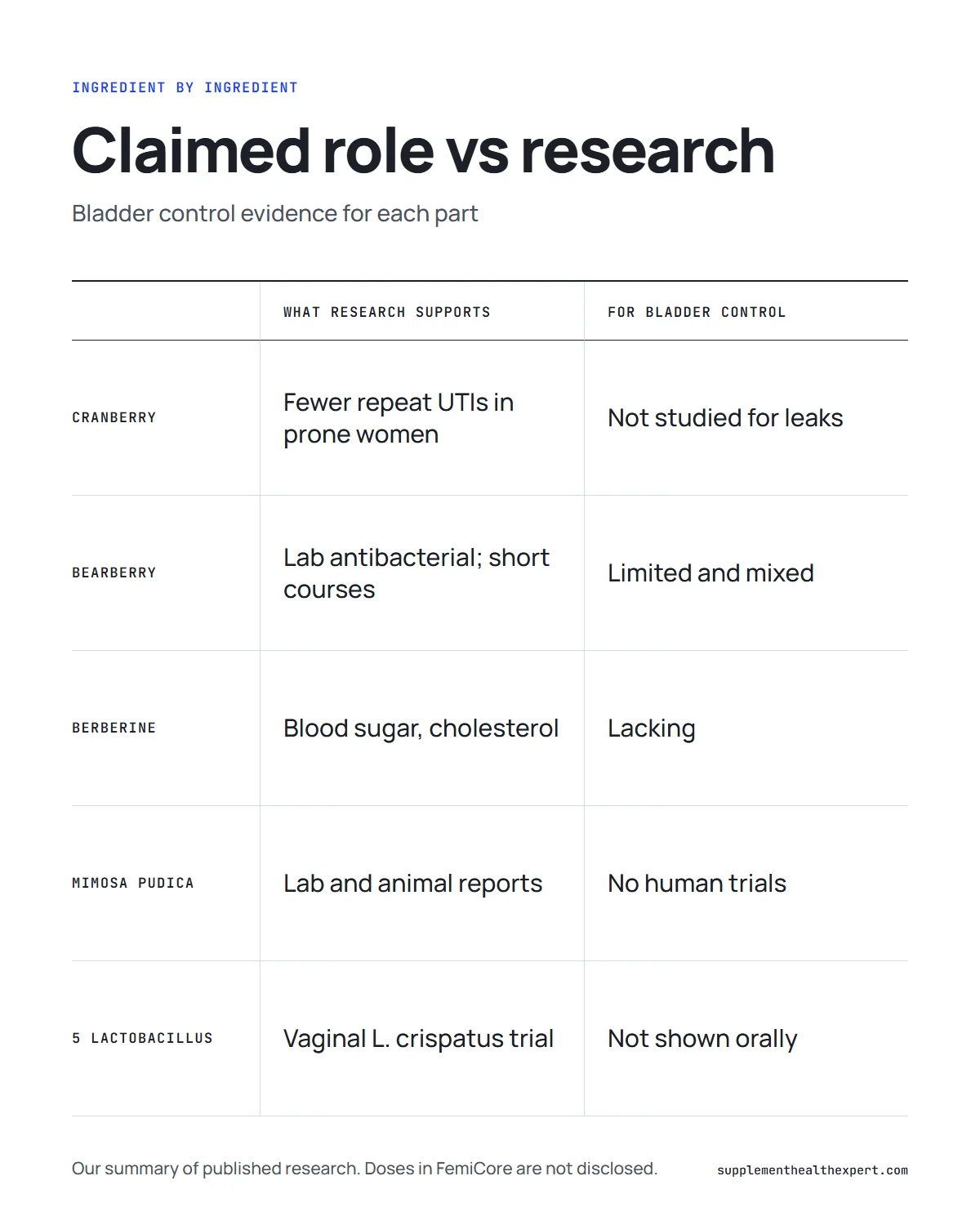
| Ingredient | Role in the seller’s story | What research supports | Evidence for bladder control |
|---|---|---|---|
| Cranberry extract | Urinary tract support | A-type PACs reduce E. coli sticking to cells; fewer repeat infections in prone women | None direct; studied for infections |
| Bearberry | Traditional urinary herb | Arbutin turns into an antibacterial compound in urine (lab) | Limited and mixed; short courses only |
| Berberine | Part of the blend | Solid human trials on glucose and cholesterol | Lacking |
| Mimosa pudica | Part of the blend | Lab and animal reports only | No human trials |
| Five Lactobacillus species | Microbiome balance | A vaginal L. crispatus product cut repeat infections in a small trial | Not shown for oral use |
Cranberry: the strongest piece, for a different problem
Cranberry contains A-type proanthocyanidins (PACs), which make it harder for E. coli bacteria to cling to the lining of the urinary tract. In 2023, a Cochrane review found that women who get frequent urinary tract infections had fewer of them when using cranberry products. Earlier reviews were more mixed, and the effect depends on how much PAC a product delivers. Two limits apply here: the research is about infections rather than leaks or urgency, and FemiCore does not state its PAC content.
Bearberry: traditional use, with a time limit
The active compound in bearberry leaf is arbutin. Once absorbed, it is turned into hydroquinone, which has antibacterial activity in urine in laboratory tests. Studies in people are few and their results disagree. In Europe, herbal medicine regulators recognise it for traditional use in mild lower urinary complaints, but only as short courses of about a week. FemiCore, by contrast, is designed for daily use over months, especially when the arbutin amount is not given.
Berberine: well studied, but not for this
Berberine is the most researched ingredient in the blend in terms of human trials, mostly for blood sugar and cholesterol, at around 1,000 to 1,500 mg a day. Studies on the bladder are lacking. It is also the ingredient in the blend with the most potential drug interactions, which matters for anyone on regular medication.
Mimosa pudica: the thinnest evidence
Work on Mimosa pudica so far comes from test tubes and animals, where it has shown anti-inflammatory, antispasmodic and antimicrobial effects. Nobody has tested it in people with bladder symptoms. Of the nine ingredients, this is the one the story leans on with the least support.
The probiotics: plausible, but strain-specific
The five Lactobacillus species are the core of the “microbiome balance” promise. One finding often linked to this idea involves L. crispatus: a vaginal (not oral) product reduced repeat urinary infections in a small placebo-controlled trial. Probiotic effects depend on the exact strain, though, and FemiCore lists only species names, so its bacteria cannot be matched to any study.
The urinary microbiome idea, in plain terms
For a long time, urine and the bladder were thought to be sterile in healthy people. From around 2012, DNA sequencing studies by researchers at Loyola University Chicago and other groups showed that the female bladder has its own community of microbes. Some of those studies found fewer Lactobacillus in women with urgency incontinence.
This is the scientific backdrop to the “microbiome balance” claim, and it is genuine. What it does not yet show is the next step the marketing implies: that a probiotic swallowed by mouth reaches the bladder community, changes it, and in turn improves bladder symptoms. That chain has not been demonstrated. The idea is plausible; the proof is not there.
Why the whole product has never been tested
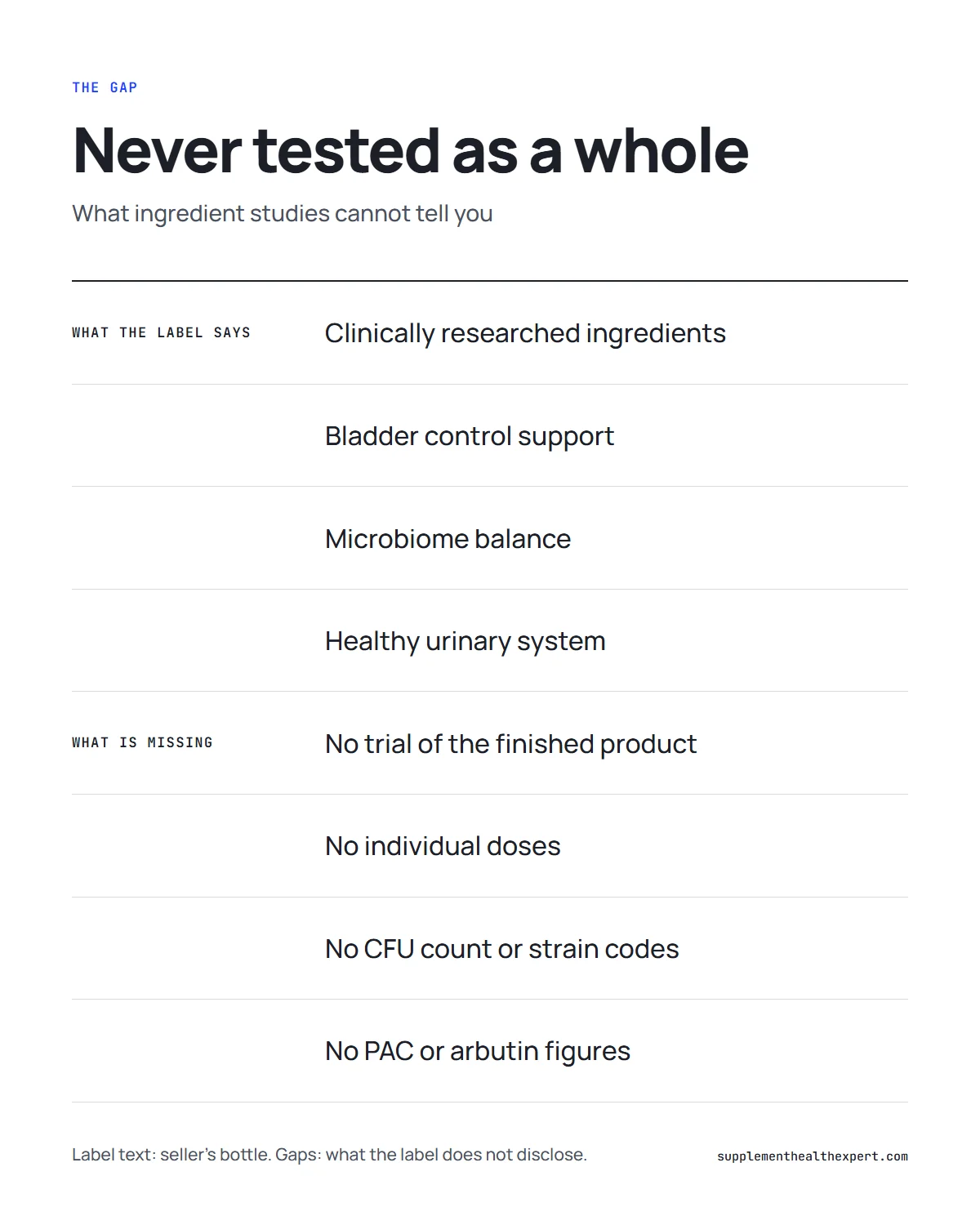
Even if every ingredient had strong bladder research, that would not tell you how this particular combination performs. There are three reasons.
- Dose. Research results come from specific amounts. Because FemiCore uses a proprietary blend, nobody outside the company knows whether the berberine is near 1,000 mg or a small fraction of it, or whether the cranberry carries a meaningful PAC level.
- Strain. Probiotic studies test named strains. FemiCore gives species only.
- Combination. Nine ingredients together could add up, cancel out or simply do nothing extra. Only a trial of the finished product could answer that.
So the most accurate one-line description is this: FemiCore combines ingredients with uneven research, mostly for purposes other than bladder control, in undisclosed amounts, and the combination has not been tested. For our wider take on the likely results, see does FemiCore really work.
Where the seller’s story and the research agree
It would be unfair to say there is nothing behind the pitch. The two sides do overlap in a few places:
- Cranberry for repeat infections has reasonable human support in women prone to them.
- The bladder microbiome is a real and active research area, not an invented concept.
- Lactobacillus crispatus has at least one small controlled trial behind it for repeat infections, although by a different route.
They part ways on the central promise. Bladder control, meaning fewer leaks and less urgency, is the benefit most buyers are looking for, and it is the one with the least direct evidence for any of the nine ingredients.
How long it would take, if it works
There is no tested timeline for FemiCore. The vendor recommends at least 3 months of daily use before judging. The money-back guarantee runs 60 days from the delivery date, so anyone following the 3-month advice will be past the refund deadline before forming a view. Decide in advance which matters more to you.
Safety follows from the same ingredients
Understanding the mechanism also explains the cautions. Probiotics can cause gas or bloating in the first week or two. Berberine may drop blood glucose and blood pressure, and it interferes with two liver enzymes (CYP2D6 and CYP3A4) that many prescription drugs depend on. Bearberry is meant for short courses and should be avoided in pregnancy, breastfeeding and kidney disease. Cranberry has case reports with warfarin. If you take regular medicines or have a health condition, speak to a doctor or pharmacist first.
A note on the seals and the FDA
The official site shows several seals, including “Made in an FDA registered facility” and “GMP Certified”, without naming the manufacturer or the certifier. As is true of every supplement on the market, FemiCore falls under the FDA’s supplement regulations, not the drug approval process. A registered facility means the factory is on the FDA’s register. It tells you nothing about how the product works.
Our verdict on the mechanism
| Question | Our answer |
|---|---|
| Is the seller’s story plausible? | Partly: the microbiome idea and cranberry have real research |
| Is it proven for bladder control? | No, not for any single ingredient or the blend |
| Can you check the doses? | No, it is a proprietary blend |
| Has the product itself been tested? | No trial found |
| Our editorial score | 6.3/10 |
FemiCore’s explanation is built from genuine research threads, stretched further than the evidence goes. That makes it a product to try with modest expectations, careful notes and a clear eye on the refund date, rather than one with a proven mechanism. Our editorial score of 6.3/10 reflects that mix of a fair purchase process and thin product-level evidence.
Frequently asked questions
How does FemiCore work, in one sentence?
According to the seller, its nine ingredients support a healthy urinary system, bladder control and microbiome balance; the research behind each ingredient is uneven, and the finished product has never been tested as a whole.
Is there a clinical trial of FemiCore itself?
Not that we could find. The label says 'clinically researched ingredients', which refers to studies on the individual ingredients in general, not a trial of FemiCore.
Which FemiCore ingredient has the best evidence?
Cranberry has the most relevant human evidence: a 2023 Cochrane review found cranberry products can lower the rate of recurring UTIs in women who keep getting them. Those studies looked at infections rather than urgency or leaks, and the benefit hinges on PAC content, a number missing from the FemiCore label.
What does the urinary microbiome have to do with bladder control?
Since around 2012, sequencing studies have shown the female bladder is not sterile, and some found fewer Lactobacillus in women with urgency incontinence. That makes the idea plausible, but it does not prove that an oral probiotic changes bladder symptoms.
Why does it matter that the doses are not listed?
Research results depend on the amount used. Berberine was studied at roughly 1,000 to 1,500 mg a day, and cranberry's effect depends on its PAC content. With a proprietary blend, you cannot tell whether FemiCore's amounts are anywhere near those levels.
How long does FemiCore take to work?
There is no tested timeline for the finished product. The vendor's advice is to give it a minimum of 3 months, while the refund window is 60 days from delivery.
Does the FDA registered facility seal mean FemiCore is proven?
No. FemiCore, as with any supplement brand, is covered by the FDA's dietary supplement regulations, not the approval system for medicines. The seal means the factory is registered; it says nothing about whether the product works.
Sources
how does femicore work · femicore · urinary microbiome · cranberry · berberine · probiotics