Supplement Reviews / Guide
FemiCore Ingredients Quick Reference: All 9 in One Table, Plus the Allergy and Medicine Questions to Ask
FemiCore ingredients on one screen: the 9 ingredients in a single table, what each is studied for, why no amounts are given, and what to ask before you buy.
- Author
- Supplement Health Expert Editorial Team
- Published
- Reading time
- 7 min
- Sources
- 2 cited
Key takeaways
- 01 FemiCore has 9 ingredients: four plant ingredients (Mimosa pudica, bearberry, cranberry extract, berberine) and five Lactobacillus probiotic species.
- 02 All nine sit in a proprietary blend. No individual amount, CFU count, strain code, cranberry PAC level or bearberry arbutin level is disclosed.
- 03 Cranberry has the most relevant research, for repeat urinary infections in women prone to them. Mimosa pudica has the thinnest, with no human trials for bladder symptoms.
- 04 Berberine and bearberry raise the most medicine and pregnancy questions. Cranberry matters for warfarin users and people with kidney stones.
- 05 There is no clinical trial of the finished FemiCore formula, so the research applies to ingredients, not to the product.
This is the short version. The FemiCore ingredients fit on one screen: nine names, four of them plants and five of them probiotics, with no amounts given for any of them. Below you will find them in one table, a line on what each one has actually been studied for, and the allergy and medicine questions worth asking before you pay for a bottle.
If you want the long read, with each ingredient explained in full, go to our complete FemiCore ingredients list. This page is the reference you can check in a minute. It is written independently of the seller and is not the seller’s page. Buttons are affiliate links; we may earn a commission on orders made through them.

FemiCore ingredients in one table
| # | Ingredient | Type | What it is studied for | Amount disclosed |
|---|---|---|---|---|
| 1 | Mimosa pudica | Plant (herb) | Anti-inflammatory, antimicrobial and antispasmodic effects seen only in lab and animal work; no human bladder trials | No |
| 2 | Bearberry (uva ursi) | Plant (leaf) | Traditional short-course use for mild lower urinary complaints; its arbutin becomes an antibacterial compound in urine in lab work | No |
| 3 | Cranberry extract | Fruit extract | Women who keep getting urinary infections had fewer of them (2023 Cochrane review); depends on PAC dose | No |
| 4 | Granular berberine | Plant compound | Blood sugar and cholesterol in human studies; bladder evidence lacking | No |
| 5 | L. crispatus | Probiotic | A small placebo-controlled trial of a vaginal product found fewer repeat infections | No |
| 6 | L. acidophilus | Probiotic | Common probiotic species; strain not named, so specific research cannot be matched | No |
| 7 | L. plantarum | Probiotic | Common probiotic species; strain not named | No |
| 8 | L. gasseri | Probiotic | Common probiotic species; strain not named | No |
| 9 | L. casei | Probiotic | Common probiotic species; strain not named | No |
The seller describes the blend as non-GMO and free of stimulants. The front of the bottle mentions clinically researched ingredients. That is true of the ingredients as a group, but no trial has tested FemiCore itself.
Reading the table in thirty seconds
Three groups make up the formula, and each plays a different role. Knowing which group an ingredient belongs to tells you most of what you need: what kind of research exists for it, and which safety questions it raises.
The urinary-tract pair. Cranberry and bearberry are the two ingredients with a direct link to the urinary tract. Cranberry has the strongest research of the nine, but it is about infections, not leaks or urgency. Bearberry has a long traditional history, with limited and mixed human evidence, and is meant for short courses.
The two outliers. Berberine is well studied, just not for the bladder. Mimosa pudica has the least evidence of anything in the capsule. Both are there for reasons the seller has not set out in detail.
The probiotics. Five Lactobacillus species, matching the label’s “microbiome balance” theme and the idea that the female bladder has its own bacteria. That idea comes from sequencing studies since about 2012, which found the bladder is not sterile, and some found lower Lactobacillus levels among women living with urgency incontinence. It is a reasonable idea in early science. It does not yet show that a probiotic swallowed by mouth changes bladder symptoms. For the full mechanism, see our explainer on how FemiCore works.
What “No” in the last column costs you
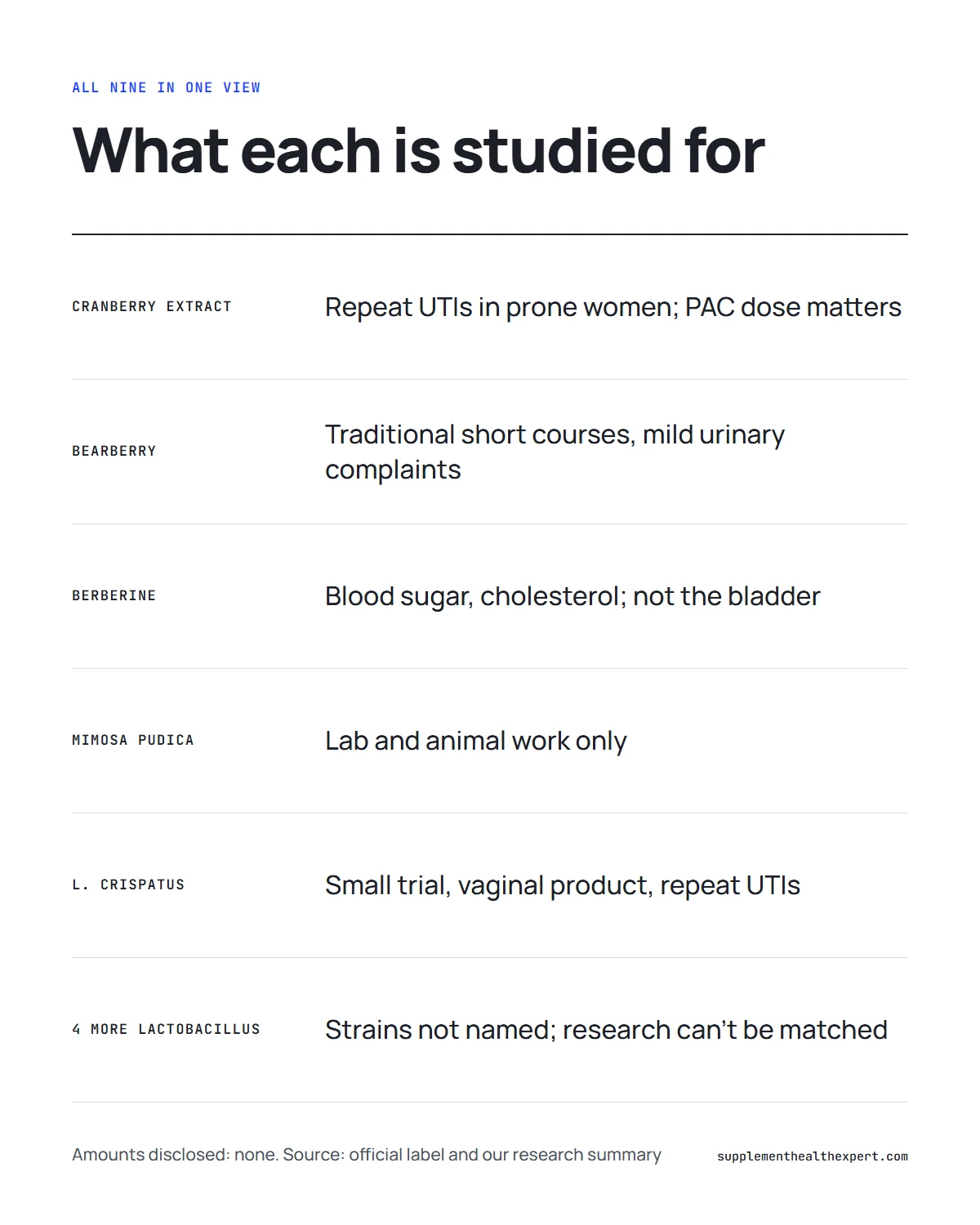
A proprietary blend is legal and common in supplements. Its practical effect is that you are taking the formula on trust. These are the details FemiCore does not publish:
- the amount of each of the nine ingredients
- the CFU count for the probiotics
- the strain codes for the five species
- how much PAC the cranberry extract provides
- how much arbutin the bearberry provides
- the berberine dose
- a certificate of analysis
Two examples show why it matters. Berberine studies on blood sugar and cholesterol use about 1,000 to 1,500 mg a day; without a figure on the label, we cannot say where FemiCore sits. Cranberry’s effect on repeat infections depends on PAC dose, and that number is also missing. The research in the table describes what an ingredient can do at a studied dose, which may or may not be the dose you get.
Allergy questions to ask before buying
We do not have a list of FemiCore’s other ingredients, such as what the capsule shell is made of. So this part is a set of questions rather than answers.
- Have you reacted to any of the nine before? Cranberry products, bearberry or uva ursi teas, berberine supplements and probiotic products are all sold on their own. A past reaction to any of them is a reason to stop here.
- Do you need to know what the capsule is made of? If you avoid certain animal products or have a known allergy to a capsule material, ask support before ordering or check the label when it arrives.
- Do probiotics usually upset you? Gas and a bloated feeling during the opening week or two are common with probiotics. If that has been hard for you in the past, expect it here too.
- Is anyone in the house severely immunocompromised? Rarely, probiotics have led to infections where the immune system is badly weakened. That is a doctor question, not an allergy one, but it belongs on the same checklist.
Medicine questions to ask before buying
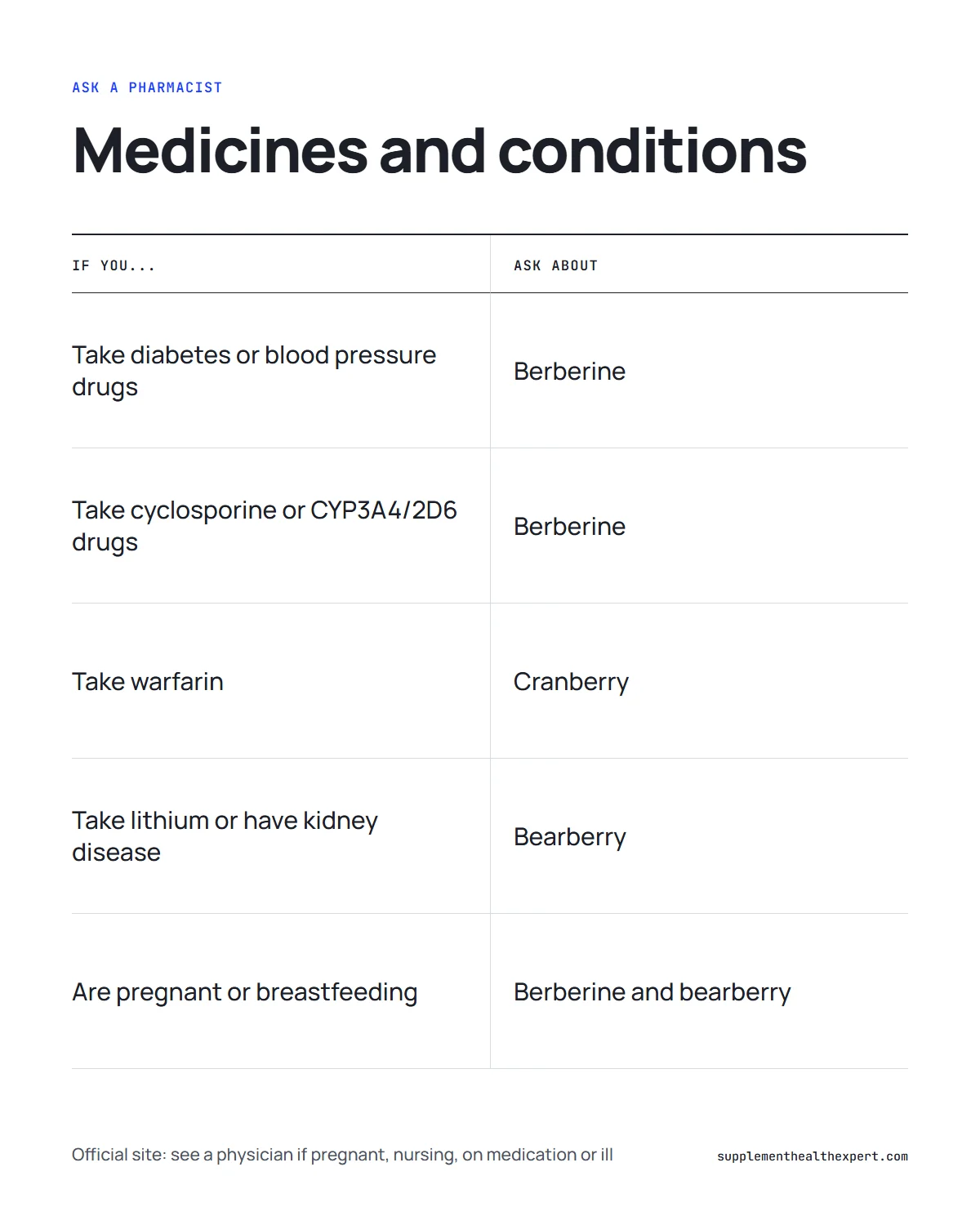
This is where the ingredient list does the most work. Take it to a pharmacist with your own list of medicines, and use this table to know which ingredient to point at.
| If you… | Ask about | Why |
|---|---|---|
| Take diabetes medicine | Berberine | It can lower blood sugar |
| Take blood pressure medicine | Berberine | It may lower blood pressure |
| Take cyclosporine or other drugs cleared by CYP3A4 or CYP2D6 | Berberine | It slows those enzymes, which can raise drug levels |
| Take warfarin | Cranberry | Case reports of interaction; INR checks may be needed |
| Take lithium | Bearberry | Known interaction |
| Have kidney disease | Bearberry | Should be avoided |
| Have had kidney stones | Cranberry | Oxalate content |
| Are pregnant or breastfeeding | Berberine and bearberry | Both should be avoided |
The official site gives its own short version of this: a physician visit first for women who are pregnant or nursing, for people taking medication and for anyone with a medical condition. With berberine and bearberry in the capsule, that advice deserves to be taken literally. Our FemiCore side effects guide covers what each ingredient can do once you are taking it.
Bearberry and the length of a course
One more question links the ingredient list to how you use the product. European herbal regulators describe bearberry’s traditional use as short courses of around a week, not continuous use. With FemiCore the capsule is daily, and the seller suggests keeping it up for at least 3 months. The bearberry amount is not disclosed, so we cannot say how much you would take over that time. If you plan a long course, this is the ingredient to mention to your doctor.
It also explains a harmless thing you might notice: bearberry can turn urine a green-brown colour. On its own that is not a reason to worry, but the symptoms in the box above still are.
Our quick take on the FemiCore ingredients
The formula has a sensible core, with cranberry and a probiotic species that has some relevant research, alongside two ingredients with little bladder evidence and a lot of undisclosed detail. Every ingredient is real and has been studied for something. None of them has been tested in this exact combination, at these unknown amounts, for bladder control.
We give FemiCore an editorial score of 6.3/10 (how we score), with transparency the weakest area. If the table above raises no red flags for you, and your pharmacist is happy with your medicines, the 60-day guarantee from delivery lets you try it with limited risk. For the wider picture, visit the FemiCore hub.
Frequently asked questions
How many ingredients does FemiCore have, and of what kind?
Nine. Four are plant-based: granular berberine, cranberry extract, bearberry (also called uva ursi) and Mimosa pudica. The other five are probiotics from the Lactobacillus group: casei, gasseri, plantarum, acidophilus and crispatus.
Can I compare FemiCore's doses with the doses used in studies?
Not really. The amounts are hidden inside a proprietary blend. Studies of berberine usually give around 1,000 to 1,500 mg daily, and with cranberry the PAC level is what counts. FemiCore publishes neither number.
Which of the nine should I raise with a pharmacist?
Berberine first, because it can change how the body handles many drugs and can lower blood sugar and blood pressure. Then cranberry if you take warfarin, and bearberry if you take lithium or have kidney disease.
Could I be allergic to something in FemiCore?
Anyone can react to a plant extract or a probiotic. If you have reacted to cranberry, bearberry, berberine or a probiotic product before, skip it or ask a doctor. Ask support for the full list of other ingredients if your label does not show it.
Are the probiotics the same strains used in research?
We cannot tell. FemiCore names the species but not the strain codes, and probiotic effects are strain-specific. The small trial that found fewer repeat infections used L. crispatus as a vaginal product, not a capsule taken by mouth.
Is FemiCore suitable during pregnancy or breastfeeding?
Not without a doctor's agreement. Pregnancy and breastfeeding rule out berberine on current safety advice, and the same goes for bearberry. The official site also tells pregnant and nursing women to see a physician first.
Why is berberine in a bladder product?
The seller does not give a detailed reason in the material we checked. Berberine has good human research for blood sugar and cholesterol, but evidence for bladder symptoms is lacking.
Sources
femicore ingredients · femicore · berberine · cranberry extract · bearberry · probiotics for women