Women's Wellness/Ingredients
FemiCore Ingredient Reference: Nine Components, the Research Behind Each, and the Missing Doses
A reference sheet for the nine FemiCore ingredients: type, what each has been studied for, the caution that goes with it, and every amount the label leaves out.
- From $49 per bottle
- 60-day refund
- Women's Wellness
By Supplement Health Expert Editorial Team · · 6 min read
- Refund window
- 60 days from delivery
- Lowest per bottle
- $49 largest bundle
- Category
- Women's Wellness
- Our score
- 6.3/10 editorial
Key takeaways
- 01 FemiCore lists nine ingredients: four botanicals and five Lactobacillus species, all inside one proprietary blend.
- 02 No individual amount is printed, so nobody can check whether any ingredient reaches a dose used in research.
- 03 Cranberry has the strongest human data, but for repeat UTIs, not for leaks or urgency.
- 04 Berberine carries the most drug interactions, and bearberry is normally meant for short courses only.
- 05 Mimosa pudica has the thinnest evidence: lab and animal reports, no human bladder trials.
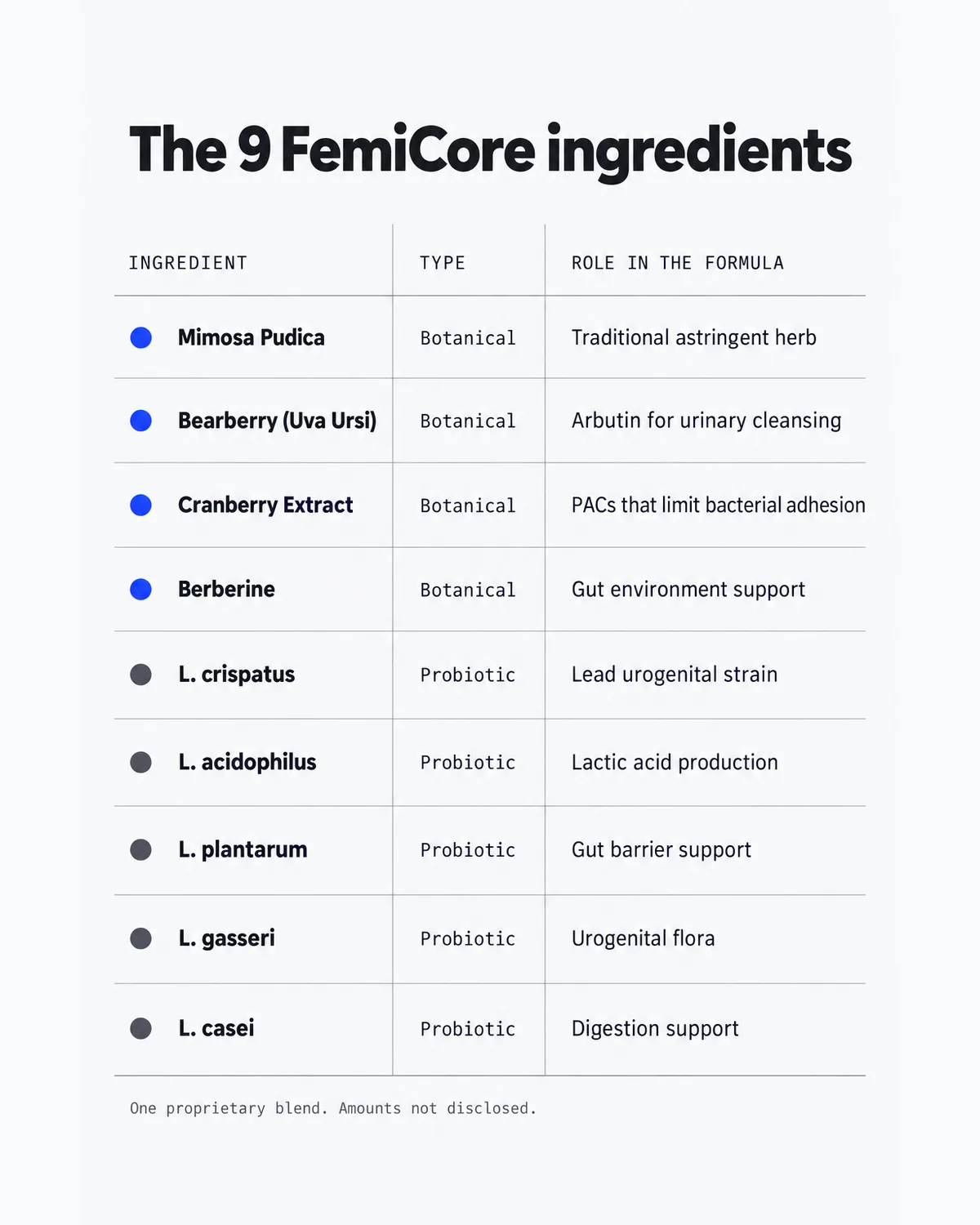
This page is a lookup sheet for what goes into a FemiCore capsule. Start with the reference table, then jump to any single ingredient for its claimed role, the state of the research and the caution attached to it. For a slower walk through the same nine names, see our long read on the FemiCore ingredients list.
Reference table: all nine ingredients
Every row shows the same thing in the dose column, because the formula is sold as a proprietary blend.
| Ingredient | Type | Studied for | Dose on label |
|---|---|---|---|
| Mimosa pudica | Botanical | Lab and animal work only | Not disclosed |
| Bearberry (uva ursi) | Botanical | Mild lower urinary complaints | Not disclosed |
| Cranberry extract | Botanical | Repeat UTIs in women | Not disclosed |
| Granular berberine | Botanical compound | Blood sugar, cholesterol | Not disclosed |
| L. crispatus | Probiotic | Repeat UTIs (vaginal use) | Not disclosed |
| L. acidophilus | Probiotic | No bladder data in our research | Not disclosed |
| L. plantarum | Probiotic | No bladder data in our research | Not disclosed |
| L. gasseri | Probiotic | No bladder data in our research | Not disclosed |
| L. casei | Probiotic | No bladder data in our research | Not disclosed |
Quick read of the table: one ingredient (cranberry) has a solid human review behind it for urinary infections. One (berberine) has good human data, but for metabolic markers rather than the bladder. The rest range from limited to nothing bladder specific.
The four botanicals
Mimosa pudica
- Role in the formula: presented as a traditional astringent herb for the bladder.
- What research says: reports of anti-inflammatory, antimicrobial and antispasmodic activity come from lab and animal studies. There are no human trials for bladder symptoms. Of all nine, this is the ingredient with the least evidence.
- Caution: no specific warning turned up in our research, but with no human bladder trials there is very little data to judge it either way.
Bearberry (uva ursi)
- Role in the formula: included for its arbutin, linked to urinary cleansing.
- What research says: arbutin is converted to hydroquinone, which shows antibacterial action in the lab when it reaches the urine. Human evidence is limited and mixed. One trial (ATAFUTI) tested uva-ursi extract in women with uncomplicated urinary infections. European herbal regulators recognise traditional use for mild lower urinary complaints and limit it to brief courses, roughly seven days.
- Caution: nausea is possible, and urine may turn green-brown (harmless). It is meant for short-term use, so taking it every day for months sits outside that guidance. Avoid it in pregnancy, while breastfeeding, with kidney disease and in children. It has a known interaction with lithium. The arbutin content is not stated.
Cranberry extract
- Role in the formula: supplies A-type proanthocyanidins (PACs), which reduce how well E. coli bacteria stick to the urinary tract wall.
- What research says: a 2023 Cochrane review concluded that cranberry products can reduce repeat UTIs in women who are prone to them. Earlier reviews were mixed, and the benefit depends on how much PAC is delivered. All of that research is about infections, not leaks or a sudden urge to go.
- Caution: there are case reports of interaction with warfarin, so anyone on it needs their INR watched. Cranberry contains oxalate, a concern for people who form kidney stones. The PAC content of FemiCore is not given.
Granular berberine
- Role in the formula: described as support for the gut environment.
- What research says: berberine has good human data for blood sugar and cholesterol, from studies giving people between 1,000 and 1,500 mg per day. There is no real evidence for the bladder. FemiCore does not say how much berberine one capsule holds.
- Caution: this is the ingredient behind most of the formula’s drug interactions. It can cause stomach and bowel effects, can lower blood sugar (relevant with diabetes medicines), may lower blood pressure, and slows the liver enzymes CYP3A4 and CYP2D6, which can push up levels of drugs such as cyclosporine. It is considered unsafe in pregnancy and breastfeeding. Our FemiCore safety sheet lays out the interactions in table form.
The five probiotic species
The seller lists Lactobacillus species, not strains. That distinction matters, because research results in probiotics apply to a specific strain, identified by a code after the species name, and FemiCore gives no codes.
L. crispatus
- Role in the formula: the lead urogenital species.
- What research says: when researchers gave an L. crispatus product vaginally in a small study against placebo, repeat UTIs went down. FemiCore is swallowed, not used vaginally, and its strain is unknown, so that result does not carry over directly.
- Caution: gas or bloating can show up in the first one to two weeks of any probiotic.
The other four species
| Species | Role given by the seller | Bladder evidence found |
|---|---|---|
| L. acidophilus | Lactic acid production | None specific |
| L. plantarum | Gut barrier support | None specific |
| L. gasseri | Urogenital flora | None specific |
| L. casei | Digestion support | None specific |
These four are common probiotic species. Our research turned up no bladder-specific trials for them, and without strain codes or a CFU count there is nothing to match against other studies. The safety note is the same for all five: gas or bloating early on, and a rare risk of infection in people whose immune system is severely weakened.
Why probiotics are in a bladder formula at all
The idea rests on the urinary microbiome. From about 2012, sequencing studies, some of them run at Loyola University Chicago, detected bacteria living in the female bladder, so it is not a sterile organ. A few of those studies reported lower Lactobacillus levels in women with urgency incontinence. That is a plausible starting point, but it is early science. It does not show that swallowing probiotics changes bladder symptoms. The benefits map scores each label claim against this kind of evidence.
What the label leaves out
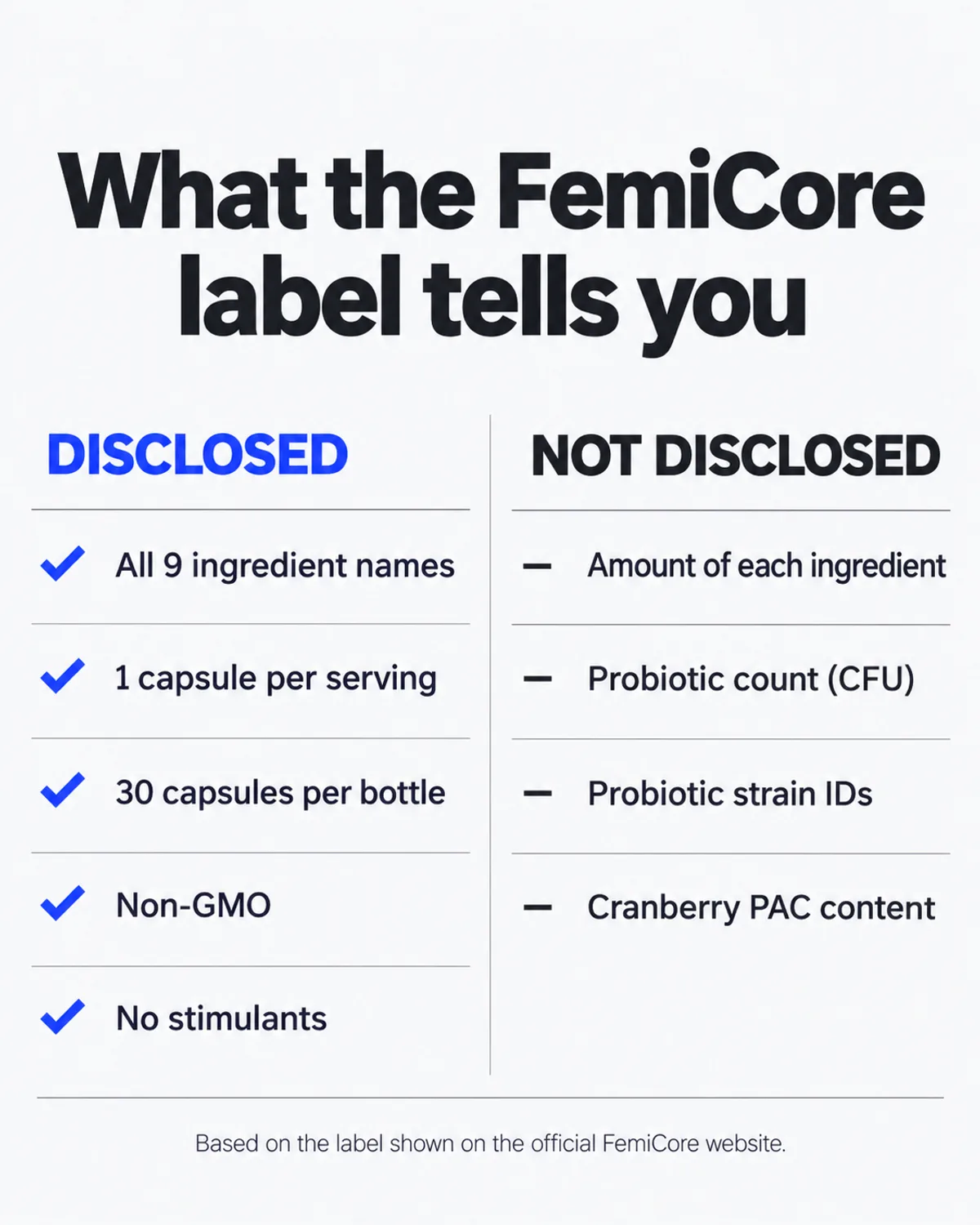
Use this as a checklist when reading the label. Every box below stays unticked for FemiCore:
- Amount of each of the nine ingredients
- CFU count for the probiotic part
- Strain codes for the five Lactobacillus species
- PAC content of the cranberry extract
- Arbutin content of the bearberry
- Berberine dose per capsule
- A published certificate of analysis
What the label does state: all nine names, one capsule per serving, 30 capsules per bottle. Two further descriptions come from the seller: no stimulants, and non-GMO.
Reading a proprietary blend: three practical points
- Order is not proof of amount. Without numbers, an ingredient listed first could still be present in a small quantity.
- Berberine is the dose that matters most for safety. Its interactions apply whatever the amount, so assume they are relevant.
- Bearberry is the dose that matters most for duration. Short-course guidance clashes with a product meant to be taken daily for at least 3 months, as the vendor suggests.
For how these gaps feed into our overall judgement, see the FemiCore review page and our methodology.
Official bundle pricing
As listed on the official store · confirm at checkout
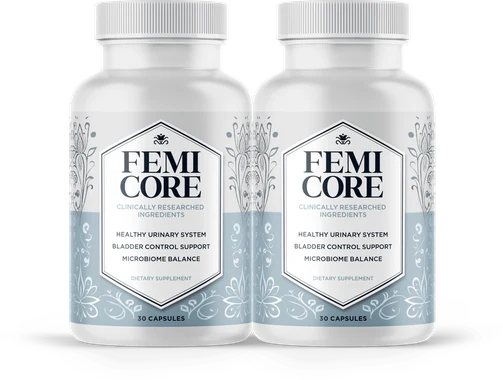
2 bottles
$358seller's regular price
$158
$79 per bottle
Seller lists a $200 saving
- $9.99 US shipping
- 60-day guarantee
3 bottles
$537seller's regular price
$207
$69 per bottle
Seller lists a $330 saving
- Free US shipping
- 60-day guarantee
6 bottles
$1,074seller's regular price
$294
$49 per bottle
Seller lists a $780 saving
- Free US shipping
- 3 bonus guides
- 60-day guarantee
Regular prices and savings are the seller's own reference figures. Refunds: 60 days from delivery. Affiliate links: we may earn a commission at no extra cost to you.
Frequently asked questions
How many ingredients are in FemiCore?
Nine. Four are botanicals (Mimosa pudica, bearberry, cranberry extract and granular berberine) and five are probiotic species (L. crispatus, L. acidophilus, L. plantarum, L. gasseri and L. casei). All nine sit inside one proprietary blend with no amount shown for any of them.
Does the FemiCore label show the CFU count?
No. The label does not give a CFU count for the probiotic part of the blend, and it does not give strain codes either. Without those two details you cannot match the probiotics to any specific study, because results in probiotic research are tied to particular strains.
Which FemiCore ingredient has the best research?
Cranberry. A 2023 Cochrane review found that cranberry products can lower the number of repeat UTIs in women who are prone to them. That finding depends on the PAC dose, which FemiCore does not disclose, and it does not cover leaks or urgency.
Which ingredient needs the most care?
Berberine, because it can lower blood sugar, may lower blood pressure and slows the enzymes CYP3A4 and CYP2D6, which can raise blood levels of many medicines. Bearberry also needs care because it is normally meant for short courses, not daily use for months.
Is there a certificate of analysis for FemiCore?
None is published on the official site as far as our research found. A certificate of analysis would show what a batch actually contains. Its absence, together with the hidden doses, is the main transparency gap in this product.
Does clinically researched mean FemiCore itself was tested?
No. The phrase on the label refers to the ingredients in general. Each one has been studied somewhere, in some form, but no trial has tested the finished FemiCore capsule in women with bladder symptoms.
Sources
- 01 Williams G, et al. Cranberries for preventing urinary tract infections. Cochrane Database Syst Rev. 2023
- 02 Stapleton AE, et al. Lactobacillus crispatus probiotic given intravaginally for prevention of recurrent UTI. Clin Infect Dis. 2011
- 03 Afshar K, et al. Uva-ursi extract and ibuprofen for uncomplicated UTI in women (ATAFUTI). Br J Gen Pract. 2018
- 04 Yin J, Xing H, Ye J. Efficacy of berberine in patients with type 2 diabetes mellitus. Metabolism. 2008
- 05 Wolfe AJ, et al. Evidence of uncultivated bacteria in the adult female bladder. J Clin Microbiol. 2012
- 06 Pearce MM, et al. The female urinary microbiome in women with and without urgency urinary incontinence. mBio. 2014
- 07 NIH Office of Dietary Supplements. Probiotics: Fact Sheet for Health Professionals
femicore ingredients · femicore proprietary blend · femicore probiotics · femicore bearberry · femicore berberine · femicore cranberry