Supplement Reviews / Guide
The Genius Song Gamma Waves: What Gamma Research Shows, and What It Does Not
The genius song gamma waves pitch, set against real research: gamma rhythms, 40 Hz light and sound studies, meditators' EEG and binaural beat reviews.
- Author
- Supplement Health Expert Editorial Team
- Published
- Reading time
- 9 min
- Sources
- 5 cited
Key takeaways
- 01 Gamma waves are real: fast brain rhythms of roughly 30 to 100 Hz that researchers link to attention and memory processing.
- 02 The best-known 40 Hz light and sound work, from MIT, was done mainly in mice bred to model Alzheimer's disease, with small early human trials. It says nothing about luck, wealth or IQ.
- 03 Binaural beat research is mixed: a 2019 meta-analysis reported a medium average effect on lab tasks, while a 2023 review found only 5 of 14 studies supported brain entrainment. No published study has tested The Genius Song track.
- 04 The seller's own Terms call its products "for entertainment purposes only". Treat the gamma story as marketing built on real terms, not as proven science.
The whole sales pitch behind The Genius Song rests on one idea: a brain rhythm called gamma, which the presenter says lies dormant in most adults until his track wakes it up. If you searched for the genius song gamma waves, you probably want to know whether that idea has any science behind it. It does, in part. Gamma rhythms are real and well studied. What the research shows about them, though, is a long way from what the video promises, and this page sets the two side by side without hype in either direction.
Our position, stated plainly: this page is written by an independent team, not by anyone connected to the seller. The buttons carry affiliate tracking and can earn us a commission on an order. We have no stake in how the science comes out.
The Genius Song gamma waves claim, in the seller’s words
The video calls gamma “the super brain wave” and describes adults’ gamma as switched off by modern life. Its fix is a “seven minute sound wave” that, according to the presenter, uses brain entrainment to begin “activating your gamma by connecting several regions of your brain to each other”. He adds that it “starts working the very first time you listen”.
From there, the claimed outcomes get very broad: sudden insights, faster learning, better memory, more luck and “synchronicities”, promotions and money, smoother relationships, and stories about weight, smoking and headaches. All of those are the seller’s statements. Not one comes with data we could examine.
The pitch even contradicts itself on timing. Its hook teases a “seven second” trick; the checkout sells seven minutes of audio, and no distinct seven-second ritual is ever demonstrated.
What gamma rhythms actually are
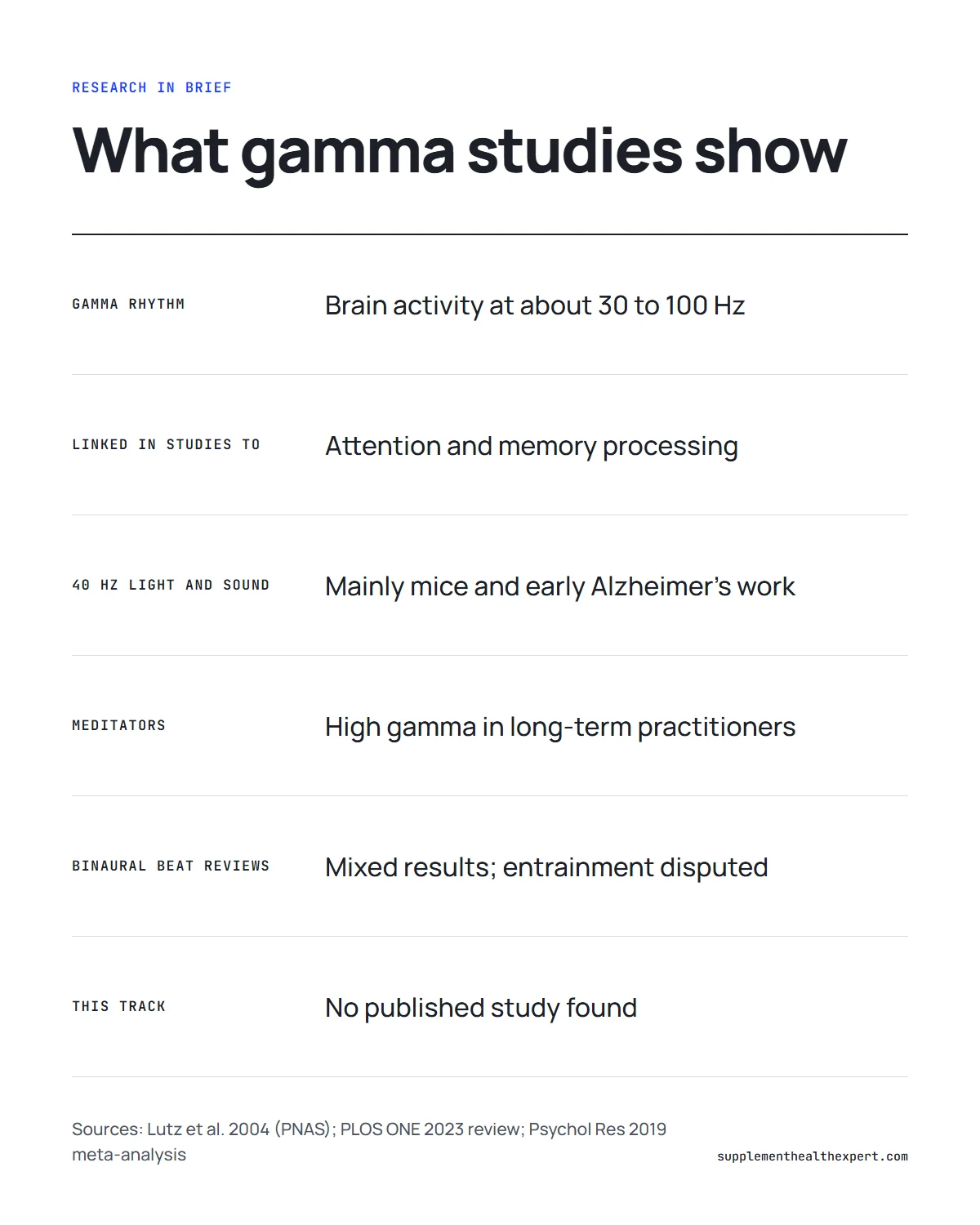
Your brain’s electrical activity rises and falls in rhythms that scientists group by speed. Gamma covers the fast end, roughly 30 to 100 cycles per second (Hz). It shows up on EEG recordings in everyone. In research, gamma activity is associated with moments when the brain is binding information together, such as paying attention to something or holding it in memory.
Two points get lost in sales copy. First, gamma is not a dormant superpower that most people lack; it is part of normal brain function. Second, seeing more gamma during a task is a measurement, not a cause. Finding that a rhythm appears while people concentrate does not show that pushing the rhythm from outside will make them concentrate better.
The 40 Hz light and sound studies
The research most often borrowed by gamma marketing comes from MIT, where the Tsai lab has explored stimulation with light flickering and sound clicking 40 times per second. Most of that work has been carried out in mouse models of Alzheimer’s disease. Small, early trials in people have followed.
It is serious science, and it is also narrow. It concerns a specific disease and its early stages of testing. It does not study IQ, creativity, wealth or luck, and it has nothing to do with this product. A sales video that drops the MIT name while promising money and promotions is borrowing prestige from work that points somewhere else entirely.
Meditators and gamma: the 2004 Lutz study
In 2004, Lutz and colleagues at the University of Wisconsin published an EEG study in the journal PNAS. They recorded long-term Buddhist practitioners during meditation and found sustained high-amplitude gamma oscillations and synchrony, in patterns that differed from those of control subjects.
This looks like the source of the video’s line that “researchers in Wisconsin even studied a monk known as the happiest man alive and found his brain was pure gamma wave”. The real study is more modest. It measured people with many years of mental training, and it did not test whether a recording could put an untrained listener into the same state.
Binaural beats and sound entrainment: what the reviews find
Brain entrainment through sound usually means binaural beats, where each ear receives a slightly different tone, or pulsed tones at a set rate. Researchers have tested these for years, and the summaries are cautious:
| Study | What it looked at | What it found, briefly |
|---|---|---|
| Garcia-Argibay et al., Psychological Research, 2019 | Meta-analysis of 22 studies on memory, attention, anxiety and pain | A medium average effect, varying with beat frequency and listening time |
| Ingendoh et al., PLOS ONE, 2023 | Systematic review of 14 studies on whether binaural beats entrain brain rhythms | 5 supportive, 8 contradictory, 1 mixed; methods too varied to compare well |
| Ross and Lopez, Scientific Reports, 2020 | 40 Hz binaural beats during attentional blink training over three days | One lab study; the 40 Hz beats sped up training gains |
| Any study of The Genius Song | The track itself | None published that we could find |
The fair summary: beats at certain rates can shift scores on some lab tasks, but whether they truly drive brain rhythms is still disputed, and results depend heavily on how each study was run. That is a long way from a daily seven-minute track changing someone’s finances or relationships.
The video’s research claims, one by one
The presentation name-checks a string of institutions. Here is how each claim stands up:
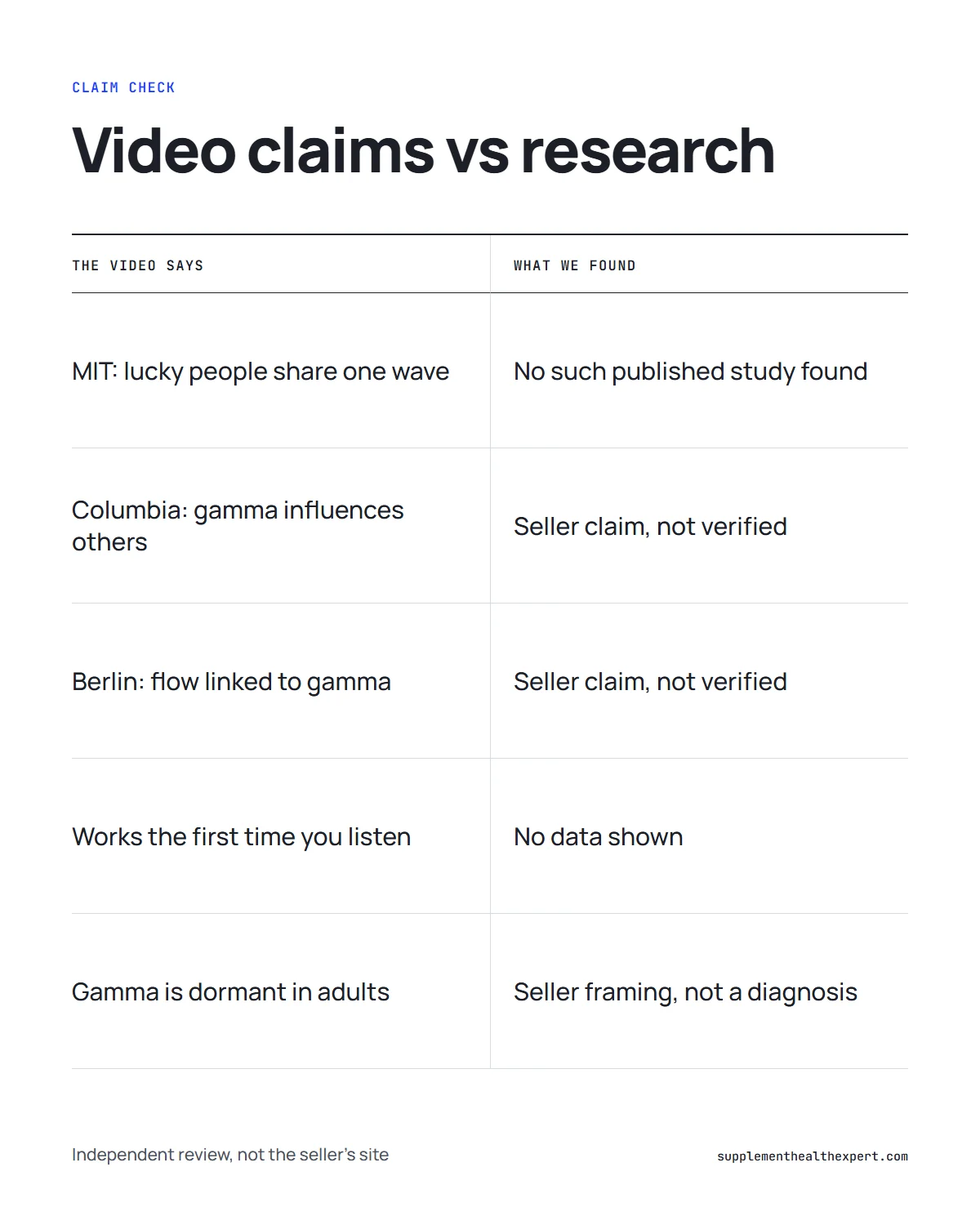
- MIT and “lucky” people. The video’s first claim credits MIT with spotting a single brain wave in every lucky, wealthy, successful person. Our search turned up no paper like it.
- Princeton. A colleague is said to hand over a Princeton report, and a paper is dated to 27 December 2025. No title, authors or journal are given, so we could not trace it.
- Einstein Center Berlin. Said to link the flow state to gamma. Unverified seller statement; the text page credits “colleagues in Japan” instead.
- Columbia University. Said to show your gamma “could influence another person”. Unverified, and the video repeats it to suggest you can help family members by listening.
- Edison and billionaires. Stories about a gamma device and 4 AM routines. Anecdotes, with no sources.
The outcome claims themselves (luck, money, memory, migraines) are tested one by one in our check of the claims behind the reviews.
The seller’s reference list and fine print
The site does carry a list of 14 references. Oddly for a gamma product, its entries lean on theta research and general entrainment papers, padded with creativity pieces (an Inc.com article, Medium posts, a TED talk), and the whole list is copied unchanged from the seller’s other audio page.
That other audio is worth knowing about. Our links open the seller’s home page, which at present features The Genius Wave, pitched as a 12-minute theta session, rather than the 7-minute gamma track. To see The Genius Song presentation you need that site’s /video/ page. They are different products with different claims, so do not mix them up at checkout.
The Terms then pull in two directions. A section headed “For Entertainment Purposes Only” says “brain entrainment is not an exact science and we recommend that you do not treat it as such”, while a later clause insists that “All claims regarding brainwave entrainment, focus, and mental energy are substantiated by established scientific research.” Readers can decide which line to believe; the research above suggests the first.
Who is telling the gamma story
The scientist narrating the video goes by Dr. Robert Lake, which the footer of the sales pages calls a pen name. His stated NASA background and decades in neuroscience come from the sales material alone; we explain the problem with that in our page on the presenter. The listener stories are covered by Terms that allow avatars, actors, changed names, paid or connected storytellers and untypical results, so they cannot stand in for evidence either.
Listening safely, whatever the science says
Our general guidance for any entrainment audio: keep the level low enough to talk over; the NIDCD lists loud listening through earbuds or headphones among the everyday causes of noise-induced hearing loss. Never play it while driving or running machinery, since the seller’s routine has you shut your eyes. Anyone who has had seizures, lives with epilepsy or has trouble hearing should get a doctor’s view before trying flickering light or pulsing sound products of any kind. And no audio track replaces medical care for memory or mood concerns.
Where that leaves the gamma pitch
Gamma is real, the 40 Hz research is real, and the meditation studies are real. The leap from those findings to a $39 track that makes you luckier or richer is not supported by anything we could find, and the seller’s own Terms decline to stand behind it as science. If you want to experiment out of curiosity, the 90-day refund through ClickBank lets you do so cheaply; ignore the separate refund page about NeuroActivate bottles, which does not apply. Price details and the crossed-out figures are covered in our discount guide.
Frequently asked questions
What are gamma waves, in simple terms?
They are one of several rhythms in the brain's electrical activity, at the fast end of the range, roughly 30 to 100 cycles per second. Researchers record them with EEG and study how they relate to attention, perception and memory. Everyone produces them; they are not a hidden ability.
Can a 7-minute audio track switch on gamma activity?
The seller says so, but we found no published study testing this particular track. Research on binaural beats is split: one meta-analysis pooled lab tasks and reported a medium average effect, while a later systematic review found that most studies did not show the brain reliably following the beat.
Is the MIT 40 Hz research about The Genius Song?
No. That work looks at flickering light and clicking sound at 40 Hz, mostly in mouse models of Alzheimer's disease, with early and small human trials. It does not involve this product and does not study luck, money or intelligence.
Did MIT find that lucky, wealthy people share one brain wave?
The sales video opens with that claim. We found no published study showing anything of the kind, from MIT or anyone else.
Do long-term meditators really show more gamma?
A 2004 study in PNAS by Lutz and colleagues found that long-term Buddhist practitioners produced sustained high-amplitude gamma activity on EEG while meditating, with patterns that differed from control subjects. It studied people with years of training, not whether a recording can produce the same state in a listener.
Could gamma audio help with Alzheimer's or memory loss?
Do not use it for that. No illness, memory loss included, is treated by The Genius Song, and even the seller's site states it is not intended to diagnose or prevent disease. Anyone worried about memory should speak to a doctor.
Is it safe to listen to gamma or binaural audio?
For most adults, listening at a gentle volume is low risk. Our general advice: not behind the wheel, not near machinery, and a doctor's opinion first for anyone with epilepsy, past seizures or hearing trouble.
Sources
- 01 Lutz A, et al. Long-term meditators self-induce high-amplitude gamma synchrony during mental practice. PNAS 2004.
- 02 Ross B, Lopez MD. 40-Hz binaural beats enhance training to mitigate the attentional blink. Sci Rep 2020.
- 03 Ingendoh RM, et al. Binaural beats to entrain the brain? A systematic review. PLOS ONE 2023.
- 04 Garcia-Argibay M, et al. Efficacy of binaural auditory beats in cognition, anxiety, and pain perception: a meta-analysis. Psychol Res 2019.
- 05 NIDCD. Noise-induced hearing loss.
the genius song gamma waves · gamma brain waves · 40 hz stimulation · brain entrainment · binaural beats