Cognitive Support/Buyer guide
The Genius Song Buyer Reference: 7-Minute Track, Pen-Name Presenter, Bonuses, Refund Rules and Score
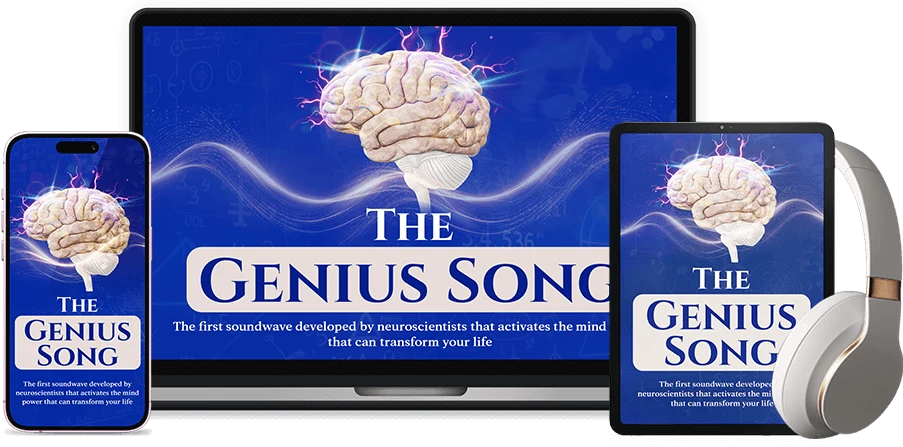
The Genius Song in one reference: a $39 audio track of about 7 minutes, a pen-name presenter, claims vs research, bonuses, the 90-day refund and our 4.7/10.
- $39 one-time price
- 90-day refund
- Cognitive Support
By Supplement Health Expert Editorial Team · · 20 min read
- Refund window
- 90 days from purchase
- Price
- $39 one-time
- Category
- Cognitive Support
- Our score
- 4.7/10 editorial
Key takeaways
- 01 The Genius Song is a digital audio track the seller says runs about 7 minutes, sold for $39 once; it is not an app or a game.
- 02 The presenter calls himself Dr. Robert Lake, and the site's own disclaimer says that name is a pen name.
- 03 Gamma research is real but mostly in mice and Alzheimer's studies; no published study has tested this track.
- 04 Refunds run for 90 days under the Terms and the ClickBank checkout, while a leftover refund page belongs to a different product.
- 05 Our editorial score is 4.7/10: a cheap trial at best, sold with marketing that contradicts itself.
This is our reference file on The Genius Song, a short audio recording promoted through a 39-minute sales video and paid for on a ClickBank checkout page. It follows the order in which a careful buyer usually checks things: what the purchase is, what it costs, what the seller promises, how much of that holds up, and how refunds work. Each section links to a sub-page that goes further on one topic.
The 30-second take
Our editorial score: 4.7/10. This is our own editorial judgment across six categories, not a customer rating and not an average of anyone’s reviews; the method is set out on how we score. Each of the six numbers is argued separately on our Genius Song scored verdict.
- The purchase: a digital audio track that the seller says lasts about 7 minutes, for $39 paid once. No app, no game, nothing posted to your door.
- The pitch: a “dormant” gamma brain wave, supposedly switched back on by a “sound wave”, plus stories about insight, luck, money, weight and pain.
- The presenter: introduced on screen as a doctor named Robert Lake, a name the site’s own footer disclaimer calls a pen name.
- The proof: gamma research is genuine, mostly in mice and Alzheimer’s work. This recording has never been put through a published study.
- The safety net: 90 days to request a refund, stated in the Terms and again at the ClickBank checkout.
- Our view: a low-cost experiment for a curious adult who will judge it well before day 90. Nothing more.
Six categories in one table
| Category | Score | Why, in a few words |
|---|---|---|
| What you receive | 5 | Short track, up to four extras, lists disagree |
| Evidence strength | 2 | Gamma work mostly in mice, nothing on this track |
| Transparency | 2 | Pen-name presenter, pages contradict each other |
| Value | 5 | $39 once, but free audio is everywhere |
| Guarantee and refund | 8 | Written into Terms and checkout, 90 days |
| Ease of ordering | 6 | Smooth ClickBank payment, odd landing page |
The six marks add up to 28, and 28 divided by six is 4.67, which we round to 4.7. The buying mechanics hold the score up; the presenter, the page contradictions and the missing proof pull it down.
What it is
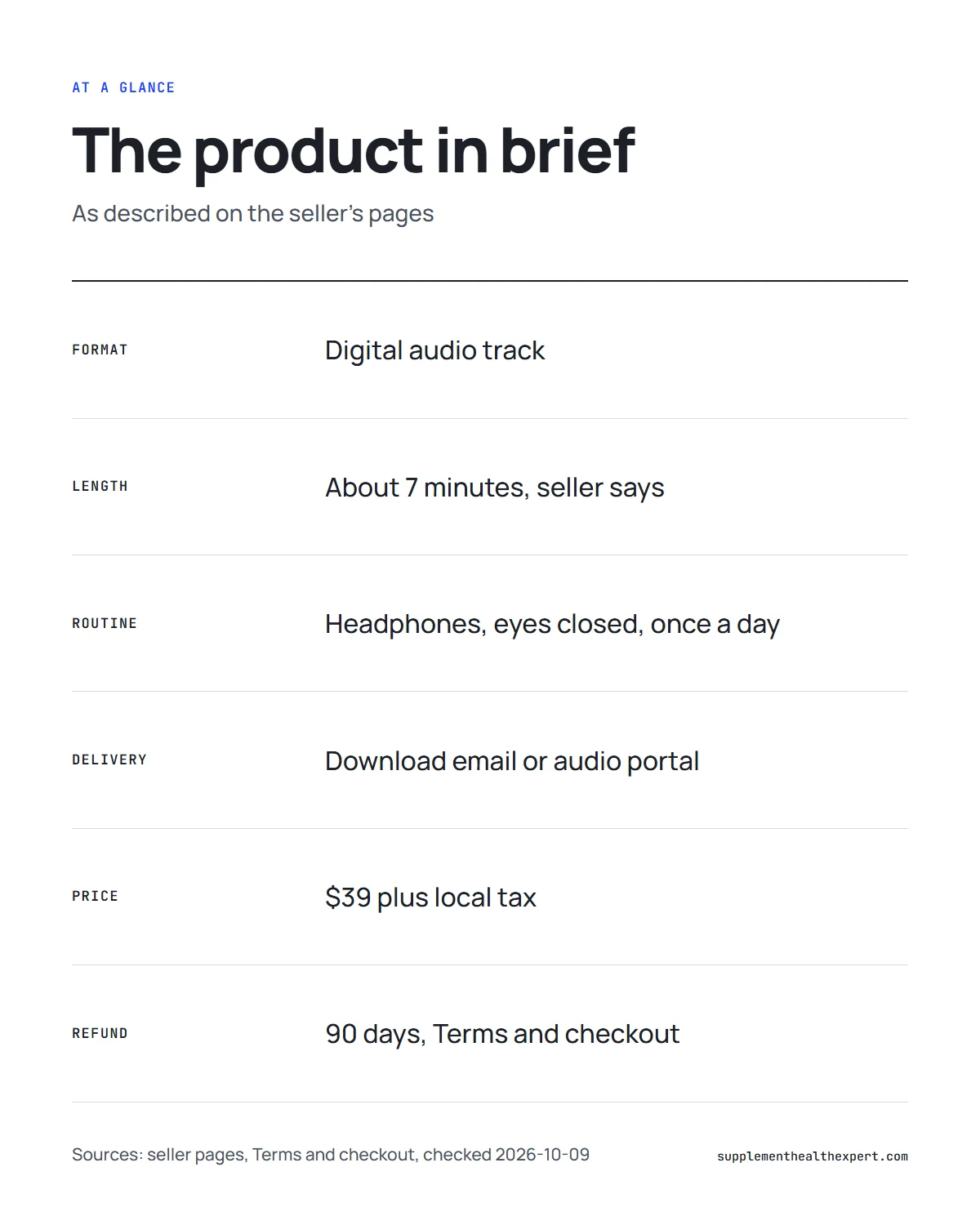
The Genius Song is a recording, and that is the whole product. In the video, the presenter says his team managed to “turn one hour of brain entrainment into a seven minute sound wave”, then gave it the name and released it as “a digital audio track”. The Terms of Sale confirm the transaction plainly: “You are paying $39 today for The Genius Song.” They call it “a copyrighted digital article for personal use”, which means a single listener, no sharing and no resale.
The suggested routine is headphones, closed eyes and one listen per day. The running time of roughly seven minutes is the seller’s own figure; we did not buy the track, so its real length and content remain unverified. For a slower walk through the basics, our explainer What is The Genius Song? covers the routine in plain language.
| Quick fact | Detail |
|---|---|
| Format | Digital audio track, called a “sound wave” |
| Length | Roughly 7 minutes (seller’s figure) |
| Daily use | Headphones on, eyes closed, once a day |
| Access | Download email or online portal (pages differ) |
| Price | $39 one time, plus local tax |
| Extras | Up to four digital bonuses, lists vary |
| Refund window | 90 days from purchase |
| Payment page | geniusbr.pay.clickbank.net |
| Seller’s site | geniussongoriginal.com |
Not an app, not a game, not a playlist
People search for a Genius Song app, a game or a Spotify playlist, and none of those exist from this seller. The site, the checkout and the video offer only the audio. The presenter even states “We only offer the Genius song direct through this website” and claims that tracks found on YouTube or Spotify are different. Any app store listing or streaming upload carrying the name is someone else’s, not the seller’s. Our What’s Included page lists each item and the access details.
Two neighboring names
Two other products sit close to this one, and keeping them apart avoids paying for the wrong thing:
- The Genius Wave lives on the same website and the same ClickBank account. The seller’s pages describe it as a 12-minute theta audio, also priced at $39. It is a separate product with its own checkout item.
- The Genius Switch comes from the same publisher, Happy Consumer, which is based in Puerto Rico, but is sold under a different ClickBank vendor ID. We mention the link as a fact only.
Why people consider it
The appeal comes mostly from how little the offer asks, not from evidence that it works:
- About seven minutes a day. Shorter than most guided meditations or a coffee break.
- A single payment. $39 at checkout, with no recurring charge in the offer.
- A long refund window. Ninety days, written down in two separate places.
- Curiosity about gamma. Brain rhythms in the gamma range are an active research topic, and 40 Hz sound studies attract headlines.
- A persuasive video. A doctor figure, named customers, research anecdotes and quick timelines.
The Genius Song is filed in our cognitive support category, next to products sold for focus, memory and mental energy. It differs from most of that shelf because nothing is swallowed. The questions that matter here are about evidence, honest marketing and safe listening, not about ingredients.
The closest match
The closest match is a healthy adult who already enjoys a short eyes-closed pause, treats $39 as the price of a trial, and is organized enough to claim a refund on time. A poor match is anyone hoping to manage a diagnosed condition, or anyone who would feel misled by a product that its own Terms label as entertainment.
Official price, in brief
The checkout charges $39, once. Next to it, the order box shows “Regular Price: $200 / $100 / $49”; those are reference amounts chosen by the seller, and we saw no sign that anyone pays them. The video first mentions $49, then announces “a special price available only through this video” of $39 and warns that the figure “is not guaranteed beyond today”. We read that as a sales technique, not a deadline.
ClickBank converts the total into your local currency and adds local tax where it applies, so the final amount on your card depends on where you live. Cost per day, the full set of urgency lines and the refund steps are on our Genius Song cost page.
How it works (the 7-minute daily routine)
The seller’s explanation runs like this: modern life leaves the adult gamma wave “dormant”, and a sound wave built with “brain entrainment” can “activate gamma by connecting several regions of your brain”. The video calls gamma “the super brain wave”. All of that comes from the sales material; no published research has measured what this recording does to a listener.
Here is the routine as the seller describes it, plus one step of our own at the end:
- Open the access email and save the track, or sign in to the portal, on a phone or computer.
- Pick a quiet place where you can sit or lie down safely.
- Put on headphones and set a moderate volume.
- Close your eyes and let the whole track play, roughly seven minutes.
- Repeat every day. According to the video, skipping a day is “okay”.
- Our addition: write down the purchase date and set a reminder for about day 75.
Volume, the Terms and the situations where a doctor should come before a download are covered on our Genius Song listening safety page.
Entrainment, briefly
Brain entrainment is the idea that a repeating rhythm, such as a pulsing sound, can nudge brain activity toward the same pace. Binaural beats are one version of it: each ear hears a slightly different tone, and the listener perceives a beat at the difference between the two. That is why headphones are part of the instructions for this kind of audio.
The seller does not publish the frequencies in its track or name the technique it uses. Nobody outside the company can therefore say whether the recording targets gamma at all. On that point, buyers have only the seller’s word.
A fair home test
Because the track is sold on changes you are supposed to notice, a short personal log is the most honest check available. Choose two or three things to rate from 1 to 5 each evening, such as how long you stayed on a single task, how much of an article you could recall, and your overall mood. Score them for a few days before the first listen, then keep going. Compare the two stretches around day 60. If the numbers have not shifted, the refund window is still open.
What the seller claims
Here are the main promises from the video, each with our rating of the supporting evidence. Some means related research exists, though it did not test this track or this outcome. Very little means only indirect or scattered data. None means we know of no research supporting the claim for any audio product.
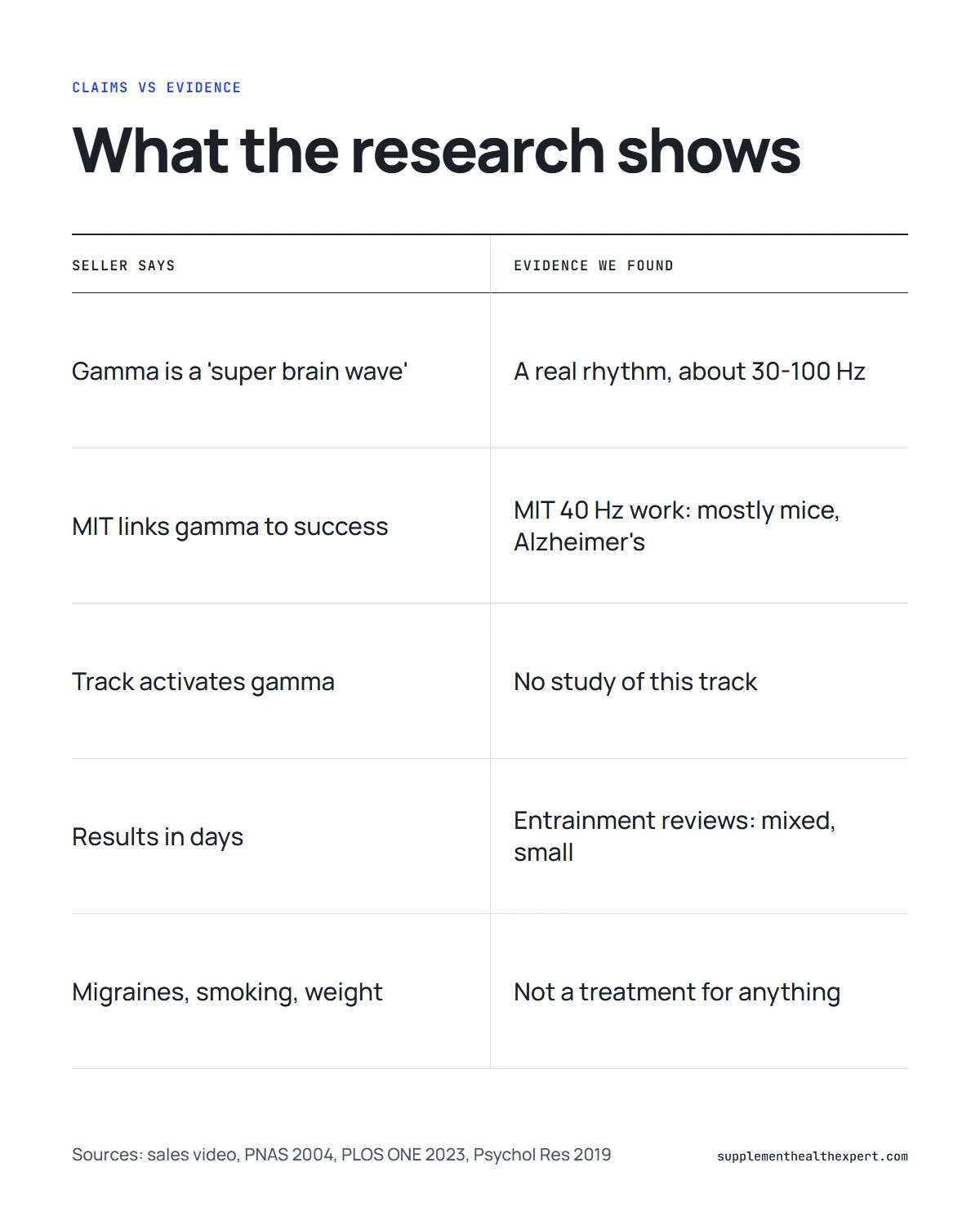
- Waking a “dormant” gamma wave. Evidence: some, indirect. Gamma activity, in a band of roughly 30 to 100 Hz, is real and has been tied in research to attention and memory processing. Whether this track changes them has never been tested.
- Eureka moments and problems solved “with little to no effort”. Evidence: very little. Entrainment experiments measure short lab tasks, not creative breakthroughs.
- Faster learning and sharper memory. Evidence: some, mixed. Reviews of binaural-beat research (a meta-analysis from 2019, a systematic review from 2023) describe small, short-lived and inconsistent effects. A 2020 Scientific Reports paper tested 40 Hz binaural beats during attention training. None used this recording.
- Luck, synchronicities and “abundance”. Evidence: none. About a casino win, the presenter concedes “there is, of course, no evidence to support that the genius song caused that”.
- Promotions, money and better relationships. Evidence: none.
- Weight loss (a 16 lb colleague story) and quitting smoking. Evidence: none for this product. Both are anecdotes in the video.
- Migraines and joint pain fading away. Evidence: none. The site’s own fine print says the product “is not intended to diagnose, treat, cure, or prevent any disease”.
- Children’s grades improving. Evidence: none.
The research stories in the video
Much of the video rests on research stories we could not confirm. Here they are, all as the seller tells them:
- MIT. “MIT found that all lucky, wealthy, successful people have this one brain wave.” MIT researchers have studied 40 Hz light and sound stimulation, largely with mice bred to model Alzheimer’s disease, plus a few small early trials in people. That work is about neither luck nor money nor IQ, and we found no study matching the claim.
- Princeton or NASA. The video cites a Princeton report and a paper “published on December twenty seventh twenty twenty five”. The text page tells the same story but credits NASA instead.
- Berlin or Japan. The video links flow states to gamma through the Einstein Center in Berlin; the text page swaps in “colleagues in Japan”.
- A British study. A double-blind experiment in which children supposedly knew who was calling them.
- Columbia University. Said to show that gamma “could influence another person”.
- Edison and billionaires. An Edison gamma device and wealthy people rising at 4 AM to catch gamma.
One piece of real research does fit the meditation side of the story. In 2004, a University of Wisconsin team writing in PNAS recorded unusually strong gamma activity in long-term meditators while they practiced. It tells us about trained meditators, not about a recorded track. Our Genius Song claims and evidence page weighs each promise in more depth, and our long-form The Genius Song review tells the full story in narrative form.
The timelines
The video gives three. The track “starts working the very first time you listen”; “many of our customers start to notice a difference” within “the first two to three days”; and “most people who listen every day for seven minutes begin to see results within a couple weeks”. No study stands behind any of them, so pick your own review date and stick to it.
Seven seconds or seven minutes?
The opening of the video promises a “seven second brain trick” and a “seven second morning ritual”, yet the product is a seven-minute track. The video never explains what the seven-second trick is beyond the recording itself. It is a small mismatch, but it fits a wider pattern of pages that do not quite agree.
Bonuses and the 90-day guarantee
Two pages, two bonus lists
The seller’s video and its text page describe the extras differently, so here is what each one names.
The sales video says “three free bonuses” and then names four:
- “The Genius Child”, an audio aimed at children’s focus
- A free copy of a classic book, more than 100 years old, about attracting financial success, which the video says “The Secret was secretly based on”
- A guided visualization by a creator the seller describes as top-rated on the Calm app
- A printable infographic of 5 habits
The text page promises “$197.00 In Free Gifts” and “4 free bonuses”, then lists three:
- The same classic book
- The “Genius Visualization”
- The “Create Your Ideal Future” infographic
| Seller page | Count it states | Items it names |
|---|---|---|
| Sales video | three | four |
| Text page | 4 | three |
Every item is digital. The Genius Child appears only in the video. We gave the extras modest weight in our score because none of them answers the central question of whether the track does anything.
The guarantee in the seller’s own words
The length is consistent wherever a number appears:
- Video order box: “(90-Day Money Back Guarantee)”, with the footer adding “90-day money-back guarantee (terms apply)”.
- Text page: “guarantee your order today for a full 90 days”.
- Terms: “For Digital Products, you may get a refund on any purchase requested within 90 days of your initial purchase.”
- ClickBank checkout: “return or replacement of any product within 90 days from the date of purchase”.
- Video narration: a “one hundred percent ironclad money back guarantee” and “whatever time you need”, with no number of days attached.
The count begins on the day you pay, not on the day you first press play.
The NeuroActivate leftover
A separate refund page on the site, at /TOS/refunds/, describes something else entirely. It is a policy for a physical product called NeuroActivate: 60 days, unopened items only, returns to an address in Tallmadge, Ohio, and its own phone number and email. The Terms also contain a section about sending physical goods from Ohio, and the footer mentions keeping “original packaging”. None of that fits an audio track. For a refund, use ClickBank’s route instead: order support at clkbank.com or 1-800-390-6035, with your ClickBank receipt ready.
What you actually receive
The seller describes access in two ways that do not match. The video says the track is “emailed to you in a matter of minutes”. The text page’s order section promises “on-demand access to your Private Audio Portal”, login details by email and streaming “from any device”, while the FAQ on that same page tells you to “download the Digital Audio Track to your phone or computer”. ClickBank’s checkout labels the order a digital product with immediate access once payment is approved.
We cannot confirm whether buyers get a download, a portal login or both, and no page names a file format. Plan for either: keep the access email, and save the track locally if a download option appears.
| You get | You do not get |
|---|---|
| A short digital audio track | An app or a game |
| Up to four digital extras | Anything sent by post |
| An access email after payment | A stated file format |
| A ClickBank receipt | A published study of the track |
| 90 days to request a refund | Medical or financial advice |
Pros and cons
| Pros | Cons |
|---|---|
| About seven minutes a day | Presenter uses a pen name |
| $39, charged once | No published study of the track |
| 90-day refund, stated twice | Terms frame it as entertainment |
| ClickBank handles payment and refunds | Testimonials may be actors or avatars |
| Nothing physical to send back | Bonus, access and customer figures conflict |
| Plays on a phone or computer | The link lands on another product’s page |
| Easy to judge with a home log | Free entrainment audio is easy to find |
Customer reviews: what we could find
The video introduces several named people: “Rachel, a nurse from Tustin, California”, “Michael in Dallas”, who the video says left his job for an Amazon business, and “Hannah from Manhattan”, whose story involves a promotion. Anecdotes about the presenter’s colleagues follow, including a finished book, a boy whose school grade supposedly jumped from a C to an A, and an engagement that began with a meeting at Trader Joe’s. The video’s question section credits questions to first names paired with cities.
The seller’s Terms change how all of this should be read. They state that names “have been changed”, that “We use pen names”, and that “Some aspects of the marketing have been dramatized”. Feedback may be performed by “digital representations, avatars, or actors”; some people featured may be “early supporters, friends, or family members of the company’s founders”; some were “compensated”; and the testimonials “are exceptional results and may not reflect the experience of a typical customer”. We treat none of them as independent reviews.
The seller’s figures are no firmer. The video says the method has helped “eighteen thousand three hundred sixty six everyday Americans”; the text page repeats 18,366 in its body but puts 19,389 in its headline. The video also speaks of “thousands of five star reviews”. We could not verify any of these numbers, and the seller’s own pages disagree with each other. In 2024 the US Federal Trade Commission finalized a rule banning fake reviews and testimonials, a good reason to ask who is speaking in any sales video. Our post Is The Genius Song a scam? separates what checks out from what does not.
What we did not do: we invented no reviews, quotes, star ratings or review counts, and we have no listening diary of our own to share. The 4.7/10 on this page is an editorial score, labeled as ours.
The presenter and the pen name
The presenter introduces himself as “doctor Robert Lake”, mentions a “New York City clinic” and claims “thirty four years as a neuroscientist”. The text page calls him a “NASA-Trained Neuroscientist”, and its headline refers to a “Top NASA Scientist”. Every one of those credentials comes from the sales pages. The footer disclaimer on both the video page and the text page reads: “Robert Lake is a pen name used with the consent of our leading neuroscientist.” The name is therefore not a real person’s name, and nothing about the credentials can be checked. We treat the presenter as part of the sales message, not as a scientific source.
The Terms, point by point
The seller’s legal pages say more about the product than the video does:
- Entertainment only. A section titled “For Entertainment Purposes Only” says brain entrainment “is not an exact science and we recommend that you do not treat it as such”.
- Not advice. A “Not Professional Advice” section rules out reading anything there as medical, financial or legal guidance.
- A contradiction. The same document also says “All claims regarding brainwave entrainment, focus, and mental energy are substantiated by established scientific research.” Both lines sit in one set of Terms.
- Personal use. One copy for one listener; no sharing or resale.
- Refunds. Digital purchases can be refunded within 90 days.
- Who sells it. The Terms name Happy Consumer LLC, a Puerto Rico company, and apply that territory’s law. Only adults (18+) may buy. The Terms were last updated on 20 Jan 2026.
- Emails. Placing an order signs you up for HappyConsumerPublishing.com newsletters. The Terms warn these may pitch outside offers, from numerology and astrology to prayer and spirituality, and each message carries an unsubscribe link.
What we can and cannot say
What the seller says
- A dormant gamma wave can be reactivated by a short sound wave
- An hour of brain entrainment has been compressed into about seven minutes
- Listeners gain insight, learning speed, memory, luck, money, relationships and health
- Results arrive from the first listen, or within a couple of weeks
What we confirmed on the seller’s pages and checkout
- It is sold as a digital audio track for $39 once, through a ClickBank checkout that labels it a “Digital Product”
- A 90-day refund period appears in both the Terms and the checkout
- Card statements show CLKBANK*Genius Song
- The site’s own disclaimer says the presenter’s name is a pen name
- The Terms include the “For Entertainment Purposes Only” section
What nobody has shown
- That the track changes brain activity in any measurable way
- That it improves focus, memory or learning for buyers
- Any effect on luck, income, weight, smoking, migraines or pain
- The actual length and content of the track (we did not buy it)
- Who the presenter really is
Skip it if
- You want help with a memory, attention or mood condition
- Your forgetfulness or poor focus is new or getting worse; see a doctor first
- You have epilepsy, a seizure history or a hearing problem and have not asked a doctor
- You know you will not track results or will miss the refund deadline
How it compares
The Genius Song is one of several ways people try to lift focus with little effort. Here are the broad types, without brand names.
| Type | Description | Research | Price |
|---|---|---|---|
| The Genius Song | One short track, daily | None on the track | $39 once |
| Free binaural or 40 Hz tracks | Generic beats from free libraries | Small, mixed | Free |
| Meditation apps | Guided sessions on a phone | Varies by app | Subscription |
| Brain-training games | Puzzles in an app or browser | Varies | Varies |
| Sleep and exercise basics | Daily habits, no product | Well studied | Free |
The research summarized earlier is about binaural beats and 40 Hz stimulation in general, so a free generic track is a no-cost way to learn whether this style of listening suits you before paying for a branded one. Our Genius Song alternatives by type page looks at each option and which one to try first.
FAQ: quick answers
| Question | Quick answer |
|---|---|
| Is it an app? | No, a digital audio track |
| How long is it? | Seller says about 7 minutes |
| How often? | Once a day, per the seller |
| What does it cost? | $39 once, plus local tax |
| Refund window? | 90 days from purchase |
| Is it proven? | No study of the track exists |
| Who is Robert Lake? | A pen name, per the site |
| On my card? | CLKBANK*Genius Song |
Sixteen longer answers are collected on our Genius Song FAQ page.
Buying guide
Before you pay
- Ignore the countdown. “Not guaranteed beyond today” is sales language, and the offer does not change because the video says it might.
- Decide how you will judge the track, and pick a check-in date around day 60.
- Read the “For Entertainment Purposes Only” section of the Terms so your expectations match the seller’s own framing.
- Ask yourself whether a calm seven-minute pause would be enough of a result on its own.
- Try a free entrainment track first if you have never listened to one.
Where the link takes you
Our links open the seller’s home page, and right now that page promotes a sister product from the same seller, The Genius Wave, rather than The Genius Song. The Genius Song presentation lives on a different page of the same site. The video page also keeps its order button hidden until roughly 18 minutes into the presentation. Read the product name on the checkout page before entering card details. Our where to buy guide explains the route step by step, and the official website check shows how to tell the seller’s real pages from copies.
At checkout
- The payment page should sit on geniusbr.pay.clickbank.net.
- The item should read “The Genius Song (90-Day 100% Money Back Guarantee)” and be labeled a digital product.
- The total appears in your home currency, with tax where your location charges it.
- Type your email address carefully; access details go to that inbox only.
After you pay
- Look for the access email straight away, and check spam or promotions folders if it is missing.
- Product questions go to [email protected].
- Order, payment and refund problems go to ClickBank order support at clkbank.com or 1-800-390-6035.
- The charge shows on your statement as CLKBANK*Genius Song.
- Expect marketing emails from GeniusSongOfficial.com; you can unsubscribe from each one.
Is it legit?
It is a real product sold through a mainstream payment processor, with a written 90-day refund, so the act of buying carries little risk. The concerns are about the marketing: a pen-name presenter, research stories nobody can trace, testimonials that the Terms allow to be acted, and pages that contradict each other on counts, bonuses and access. A legitimate sale and a proven product are different things, and The Genius Song is only the first.
How long to give it
The video’s timelines stretch from the first session to a couple of weeks, while the refund lasts 90 days. That gap favors the buyer. Listening on most days for six to eight weeks is a fair trial by the seller’s own standard and still leaves a month to decide calmly. A trial that drifts past day 90 removes the safety net.
If the track does nothing for you
- Find the ClickBank receipt email and note the purchase date.
- Confirm you are still within 90 days of that date.
- Ask for the refund through ClickBank order support, online or by phone, rather than through the NeuroActivate page.
- Keep any confirmation until the money is back on your card.
- If a refund the Terms promise is not honored, the FTC explains how disputing a card charge works.
The one-page version
For the essentials on a single screen, see our quick guide, an independent one-page summary of the same facts.
The Genius Song Official Pricing
As listed on the official store · confirm at checkout
The Genius Song audio track
$200seller's reference price
$39
One-time payment · digital delivery
Seller lists a $161 saving
- Short daily audio track (seller says about 7 minutes)
- Digital delivery after checkout
- Bonuses listed on the sales page
- 90-day money-back guarantee
A one-time digital purchase: no subscription and nothing is shipped. The checkout shows local currency and any tax, so the final amount can differ. Regular prices and savings are the seller's own reference figures. Refunds: 90 days from purchase.
Frequently asked questions
Is The Genius Song charged once or every month?
Once. The Terms of Sale say you pay $39 today for The Genius Song, and the ClickBank checkout marks the order as a non-recurring digital product. The amount shows in your local currency, with tax added where your country charges it.
What do I need to play it?
A phone or computer and a pair of headphones, which the seller asks you to wear. The seller describes both a download and an online audio portal for access, so an internet connection matters at least for the first step. Nothing physical is sent.
Who is Dr. Robert Lake?
He is the presenter of the sales video, and the footer disclaimer on the seller's own pages says the name is a pen name used with the consent of a neuroscientist. Titles such as NASA-trained neuroscientist come from the sales pages and cannot be verified.
Why does the link open a page about The Genius Wave?
The seller's home page currently promotes The Genius Wave, a separate 12-minute audio from the same site. The Genius Song presentation sits on another page of that site. Read the product name at checkout so you pay for the item you intend to buy.
Has anyone studied this track?
Not in any published work we could find. Research on gamma rhythms, 40 Hz stimulation and binaural beats exists, but it used lab sounds or light, often in mice. Results from those studies cannot be transferred to an unpublished commercial recording.
Which refund policy applies: 90 days or 60 days?
Ninety days. The Terms give digital purchases 90 days and ClickBank's checkout says the same. The 60-day page on the site describes a physical product called NeuroActivate and does not fit an audio track, so go through ClickBank order support with your receipt.
Can I share the track with my partner or children?
The Terms of Sale describe the purchase as a copyrighted digital article for personal use by one person. Passing copies to others, reselling them or uploading them elsewhere is not permitted under those Terms.
Sources
- 01 Lutz A, et al. Long-term meditators self-induce high-amplitude gamma synchrony during mental practice. PNAS. 2004
- 02 Ross B, Lopez MD. 40-Hz binaural beats enhance training to mitigate the attentional blink. Sci Rep. 2020
- 03 Ingendoh RM, et al. Binaural beats to entrain the brain? A systematic review. PLOS ONE. 2023
- 04 Garcia-Argibay M, et al. Efficacy of binaural auditory beats in cognition, anxiety, and pain perception: a meta-analysis. Psychol Res. 2019
- 05 NIDCD. Noise-induced hearing loss
- 06 FTC. Final rule banning fake reviews and testimonials (2024)
- 07 FTC. Using credit cards and disputing charges
- 08 ClickBank. Order support
the genius song · genius song buyer reference · audio track · gamma waves · brain entrainment · cognitive support · clickbank