Cognitive Support/Benefits
The Genius Song Benefit Claims Graded: Gamma, Memory, Luck and the Research Stories Behind Them
Each benefit The Genius Song's sales video promises, graded against gamma and entrainment research, plus the unverified study stories and seller timelines.
- $39 one-time price
- 90-day refund
- Cognitive Support
By Supplement Health Expert Editorial Team · · 5 min read
- Refund window
- 90 days from purchase
- Price
- $39 one-time
- Category
- Cognitive Support
- Our score
- 4.7/10 editorial
Key takeaways
- 01 Gamma rhythms are real, but research on them has not tested The Genius Song or shown it changes memory, luck or income.
- 02 The 40 Hz studies the pitch leans on are mostly in mice bred to model Alzheimer's, with early, small human work.
- 03 Reviews of binaural beats and similar audio find small, inconsistent effects on attention, memory or anxiety.
- 04 The research stories in the video (MIT, Princeton or NASA, Berlin or Japan, Columbia) could not be verified.
- 05 Even the presenter says there is no evidence the track caused one of the casino wins he describes.
The sales video for The Genius Song makes more than a dozen promises, from sharper learning to luck at a casino table. This page lines them up in a grading table, sets the gamma and entrainment research beside them, then sorts the video’s research anecdotes and timelines. Grades describe the evidence for the claim, never for the track itself, because no one has published a study of the track.
Grading key
| Grade | Meaning here |
|---|---|
| Weak | Related research exists, but small, mixed or in animals |
| Very weak | Only anecdotes from the seller |
| None | No study; seller story only, or contradicted |
Promise by promise
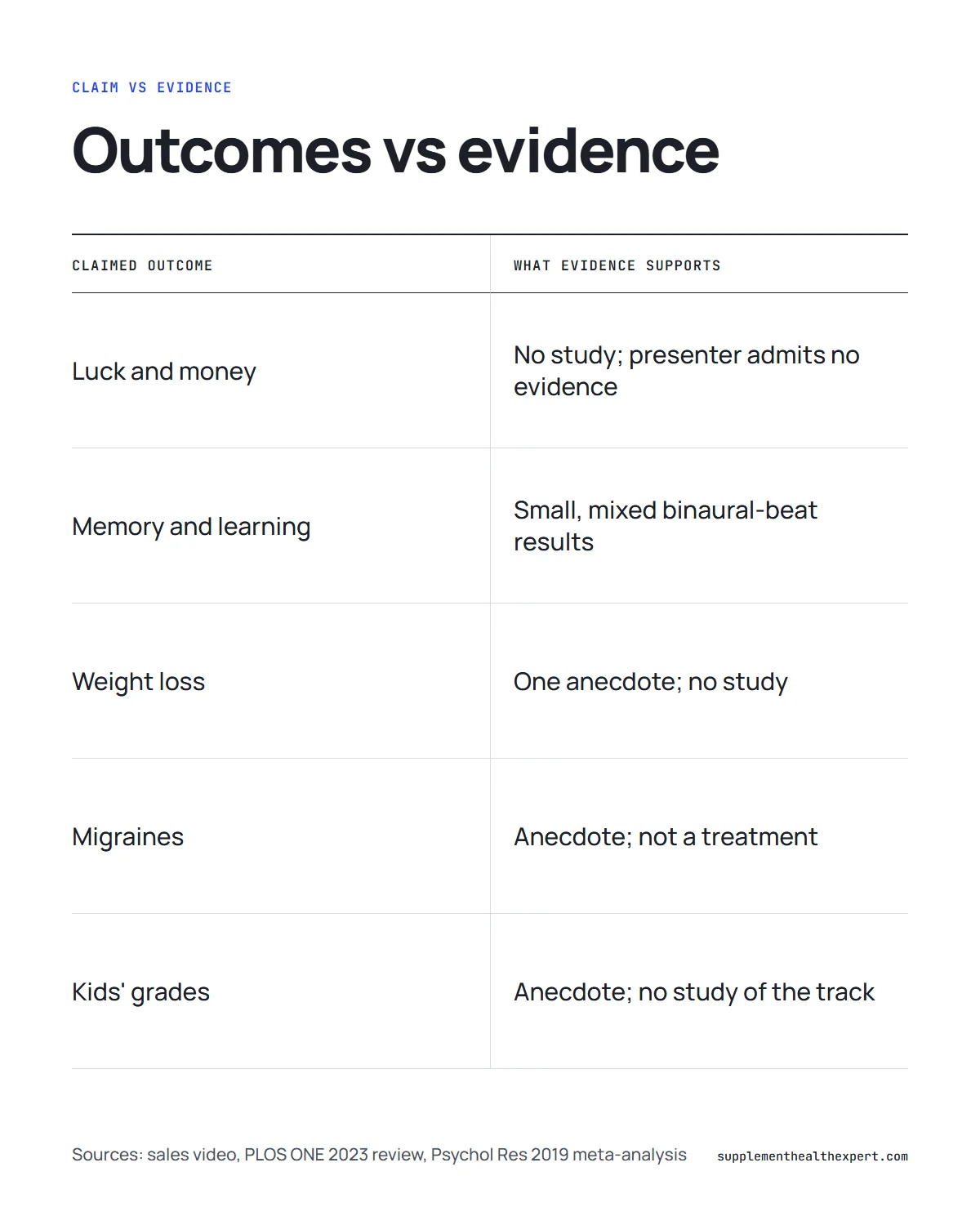
| Seller’s promise | Evidence grade | Why |
|---|---|---|
| “Activate gamma” | Weak | 40 Hz work is mostly in mice; no test of this audio |
| Faster learning, better memory | Weak | Entrainment reviews: small, mixed, short term |
| Eureka moments, effortless problem solving | None | No study links audio to insight on demand |
| Luck, synchronicities, abundance | None | Presenter admits no evidence for a casino win |
| Promotions, money, relationships | None | Colleague and testimonial stories only |
| Children’s grades and bedtime | Very weak | One anecdote (a son going from C to A) |
| Weight loss (16 lb story) | Very weak | Single anecdote; not a weight program |
| Quitting smoking | Very weak | Anecdote; not a cessation aid |
| Migraines, joint pain | Very weak | Anecdotes; site says not for any disease |
The science the pitch borrows
Gamma rhythms
Gamma is a band of fast brain activity, roughly 30 to 100 Hz, that researchers connect with attention and memory processing. The video calls it “the super brain wave” and says modern life has left it “dormant” in adults. That second idea is the seller’s framing, not a finding from the work described here.
40 Hz light and sound
The Tsai lab at MIT has tested flickering light and sound at 40 Hz, mainly in mice engineered to model Alzheimer’s disease, with small early trials in people. The aim is studying the disease, not raising IQ or attracting money. Nothing in that program evaluated The Genius Song.
Meditators
Lutz and colleagues (PNAS, 2004) found high-amplitude gamma synchrony in long-term meditators while they meditated. That is likely the source of the video’s “monk” story. The finding concerns trained meditators producing the activity themselves, years into a practice.
Binaural beats and entrainment
Two pooled analyses matter here. Garcia-Argibay’s team (Psychological Research, 2019) and Ingendoh’s team (PLOS ONE, 2023) both describe effects on attention, memory or anxiety that are modest, short-term and inconsistent from one study to the next. Our blog post on gamma waves and the track covers these studies at more length.
The video’s research stories
The narrator, who goes by “doctor Robert Lake”, tells a string of discovery stories. The site’s footer calls that name a pen name, so the stories cannot be checked against any researcher’s record. None of them came with a citation we could follow.
| Story in the video | Text page version | Status |
|---|---|---|
| MIT: lucky, wealthy people share one brain wave | Same | No such study found |
| Princeton report, paper dated 27 Dec 2025 | NASA instead | Unverified |
| Einstein Center Berlin links flow to gamma | “Colleagues in Japan” | Unverified |
| Columbia: gamma “could influence another person” | Not compared | Unverified |
| British double-blind study on kids and phone calls | Not compared | Unverified |
| Edison’s gamma device; billionaires up at 4 AM | Not compared | Unverified |
The text page swaps institutions while telling the same plot, which is a reason for caution on its own. As for the children’s “creative genius” percentages, their origin appears to be a creativity test by George Land, described in his 1992 book Breakpoint and Beyond. A peer-reviewed NASA paper with those numbers could not be found.
The seller’s reference list
The pages end with 14 references. Most concern theta waves or entrainment in general, a few are creativity articles (Inc.com, Medium, a TED talk), and the identical list appears on the page for The Genius Wave, the seller’s 12-minute theta audio. A list about theta does not back a pitch about gamma.
The presenter’s own admission
Describing a listener’s casino win, the presenter says: “there is, of course, no evidence to support that the genius song caused that”. That sentence applies with equal force to most of the outcomes in the grading table above.
Seller timelines, read as claims
| When | What the video says |
|---|---|
| First listen | “It starts working the very first time you listen” |
| Days 2 to 3 | Many customers “start to notice a difference” |
| About two weeks | Most daily listeners “begin to see results” |
None of these figures has a study behind it. If you test the track, the 90-day refund window runs well past all three, which gives time to judge it calmly. How that window works is on the price page.
Testimonials and counts
Listener stories in the video (a Tustin nurse called Rachel, a Dallas man called Michael, Hannah in Manhattan) sit alongside anecdotes about the presenter’s colleagues. The Terms say names “have been changed”, feedback may be performed by “digital representations, avatars, or actors”, and the stories “are exceptional results”. How many people the seller says it has helped also shifts between pages (18,366 against 19,389, the second from the text version’s headline). Neither number is verified. Our post on reviews of the track looks at what those stories can and cannot show.
What would change these grades
Claims like “activate gamma” are testable, which makes the absence of a test more telling. A study able to move the grades above would need:
- A controlled trial of this exact recording, compared with silence or ordinary music.
- Brain activity recorded with EEG before and after listening, by people not paid by the seller.
- Outcomes picked in advance, such as memory or attention tasks, rather than stories collected afterwards.
- Publication in a journal where other researchers can examine the methods.
Nothing of that kind exists for this product so far. That is why evidence strength sits at 2 out of 10 in our full review, an editorial judgment explained in how we score.
A realistic expectation
The most a reader can reasonably expect is a short, quiet routine that some people find relaxing. Focus or memory changes, if any, would fall inside the small and mixed range the reviews describe. Read the remaining promises as marketing. For safe listening habits, see the safety page; for free and paid alternatives, see the comparison page.
The Genius Song Official Pricing
As listed on the official store · confirm at checkout
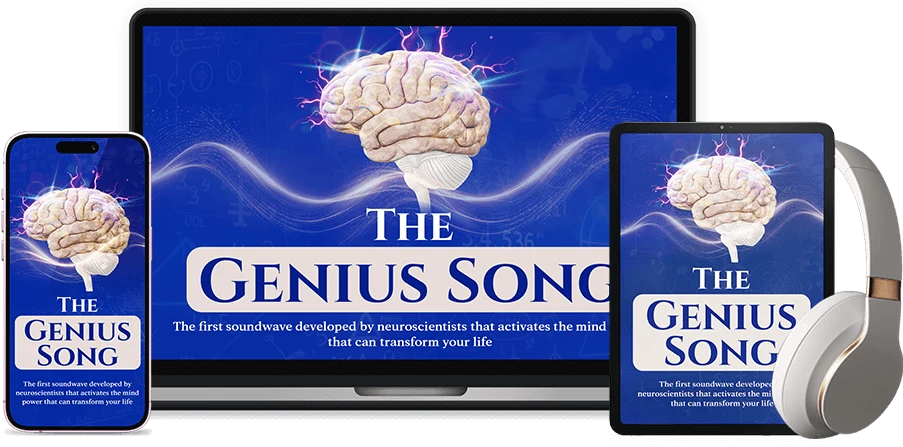
The Genius Song audio track
$200seller's reference price
$39
One-time payment · digital delivery
Seller lists a $161 saving
- Short daily audio track (seller says about 7 minutes)
- Digital delivery after checkout
- Bonuses listed on the sales page
- 90-day money-back guarantee
A one-time digital purchase: no subscription and nothing is shipped. The checkout shows local currency and any tax, so the final amount can differ. Regular prices and savings are the seller's own reference figures. Refunds: 90 days from purchase.
Frequently asked questions
Will The Genius Song improve my memory?
There is no study of this track. Broader reviews of binaural beats report small and inconsistent effects on memory and attention, usually short term. A memory benefit from this recording is a seller claim, not a documented result.
Does gamma research support the luck and money promises?
No. Gamma rhythms are studied for their role in attention and memory processing. None of the research cited in this page links them to luck, promotions, income or synchronicities. The presenter himself concedes there is no evidence for one casino story.
How fast does the seller say results appear?
The video gives three timelines: it 'starts working the very first time you listen', customers notice a difference within two to three days, and most daily listeners see results within a couple of weeks. None of these comes with data.
Can the track help with migraines, smoking or weight?
The video includes anecdotes about each, but the site itself states the product is 'not intended to diagnose, treat, cure, or prevent any disease'. See a doctor for any of these; an audio track is not a substitute for care.
Is the monk or meditator story real?
It seems to draw on a 2004 PNAS paper by Lutz and colleagues, which recorded high-amplitude gamma activity in long-term meditators. That study looked at practised meditators, not at a recorded track, and the sales version simplifies it.
Where do the testimonials fit in?
The Terms say testimonials may be dramatized, voiced by actors or avatars, given by friends or family of the founders or by compensated people, and describe exceptional results. They cannot serve as evidence of benefit.
Sources
- 01 Lutz A, et al. Long-term meditators self-induce high-amplitude gamma synchrony. PNAS, 2004
- 02 Garcia-Argibay M, et al. Efficacy of binaural auditory beats in cognition, anxiety, and pain perception: a meta-analysis. Psychological Research, 2019
- 03 Ingendoh RM, et al. Binaural beats to entrain the brain? A systematic review. PLOS ONE, 2023
- 04 FTC. Final rule banning fake reviews and testimonials (2024)
the genius song · benefits · gamma waves · brain entrainment · evidence · cognitive support