Women's Wellness/Comparison
FemiCore Versus Other Bladder Support Routes: Cranberry Alone, One Probiotic, Pelvic Floor Training, a Doctor
FemiCore set against other routes for bladder bother: a cranberry-only product, a single-strain probiotic, pelvic floor training and a doctor visit.
- From $49 per bottle
- 60-day refund
- Women's Wellness
By Supplement Health Expert Editorial Team · · 6 min read

- Refund window
- 60 days from delivery
- Lowest per bottle
- $49 largest bundle
- Category
- Women's Wellness
- Our score
- 6.3/10 editorial
Key takeaways
- 01 No study compares FemiCore with any other option, so this comparison rests on the evidence for each route.
- 02 For repeat UTIs, a cranberry product with a stated PAC dose is easier to judge than a blend that hides it.
- 03 For leaks, pelvic floor muscle training has been studied directly in women, which no supplement ingredient here can say.
- 04 A doctor visit comes first for new, painful or sudden symptoms, and its diary and tests help with every other choice.
- 05 FemiCore fits best as a time-boxed trial for mild bother after a medical check.
FemiCore is one of several routes a woman with bladder bother might take. This page lines it up against four kinds of option, not named brands: a cranberry-only supplement, a single-strain women’s probiotic, pelvic floor muscle training and a visit to a doctor or urologist. No study has compared FemiCore head to head with any of them, so each row reflects the evidence behind that route in general.
Options matrix
| Option | What it targets | Evidence strength | Typical cost |
|---|---|---|---|
| FemiCore | Urinary health, control, microbiome | Formula untested; ingredients limited | $49 to $79 a bottle (one month) |
| Cranberry-only supplement | Repeat UTIs | Moderate, PAC dose dependent | Varies |
| Single-strain probiotic | Repeat UTIs, flora | Limited, strain specific | Varies |
| Pelvic floor muscle training | Leaks | Studied directly in women (Cochrane) | Varies |
| Doctor or urologist visit | Finding the cause | The standard first step | Varies |
Fit matrix
| Option | Best for | Main drawback |
|---|---|---|
| FemiCore | Mild bother, after a medical check | Every dose hidden |
| Cranberry-only | Women prone to repeat UTIs | Not studied for leaks or urgency |
| Single-strain probiotic | Matching a named strain to research | Narrow, one strain only |
| Pelvic floor training | Women whose main problem is leaks | Needs weeks of regular practice |
| Doctor visit | Anyone with new or worrying symptoms | Takes an appointment |
How we compared the routes
Each option was weighed on four questions:
- Evidence for the specific problem: has this route been studied for infections, for leaks, or for neither?
- Transparency: can you see what you are getting, such as a PAC dose, a strain code or a structured programme?
- Safety burden: does it add drug interactions or groups who should avoid it?
- Cost and effort: money each month, or time and practice.
Safety burden by route
| Option | Interaction concerns | Groups to take care |
|---|---|---|
| FemiCore | Berberine, bearberry, cranberry flags | Pregnancy, kidney disease, many medicines |
| Cranberry-only | Warfarin case reports | Kidney stone formers |
| Single-strain probiotic | None flagged in our research | Severely immunocompromised |
| Pelvic floor training | None from a product | Ask a professional for technique |
| Doctor visit | Not applicable | Everyone can start here |
Option by option
FemiCore
- What you get: one daily capsule with four botanicals (Mimosa pudica, bearberry, cranberry, berberine) and five Lactobacillus species.
- Strength: covers several ideas at once, with a 60-day refund counted from delivery.
- Weakness: no amounts, no strain codes, no trial of the blend. Berberine brings drug interactions, and bearberry is normally a short-course herb. Details are on the safety sheet.
Cranberry-only supplement
- What you get: cranberry, ideally with its PAC content printed.
- Strength: pooled trial data in a 2023 Cochrane review point to fewer recurrent UTIs with cranberry products among women who keep getting them. A-type PACs are thought to work by stopping E. coli from attaching.
- Weakness: the benefit depends on PAC dose, earlier reviews disagreed, and none of it concerns leaks or urgency.
- Versus FemiCore: narrower, but you can see what you are taking. FemiCore’s cranberry dose is unknown.
Single-strain women’s probiotic
- What you get: one Lactobacillus strain, ideally named with its strain code and a CFU count.
- Strength: probiotic effects are tied to strains, so a named strain can be matched to its own research. The best-known bladder example: in one small study, women using a vaginal L. crispatus product had fewer recurrent UTIs than those on placebo.
- Weakness: evidence is limited and form matters: a vaginal product is not the same as a swallowed capsule.
- Versus FemiCore: FemiCore lists five species, including L. crispatus, but no strains and no CFU count, so its probiotics cannot be checked the same way.
Pelvic floor muscle training
- What you get: a programme of exercises for the muscles that support the bladder, best learned with a trained professional.
- Strength: it has been the subject of a Cochrane review of trials in women with urinary incontinence. That is direct evidence for leaks, which none of FemiCore’s ingredients has.
- Weakness: it takes regular effort over weeks, and it does not address infections.
- Versus FemiCore: aimed squarely at leaks; costs effort rather than a monthly bottle.
Seeing a doctor or urologist
- What you get: an assessment of why symptoms are happening. Expect to be asked about your pattern, often with a bladder diary, and possibly to have tests.
- Strength: the only route that can find a cause, spot an infection or rule out something serious. It also lets someone check your medicines before you add a supplement.
- Weakness: needs an appointment, and the answer may be “more than one step”.
- Versus FemiCore: not a competitor. It is the step that tells you whether a supplement is worth trying at all.
If you do pick the FemiCore route
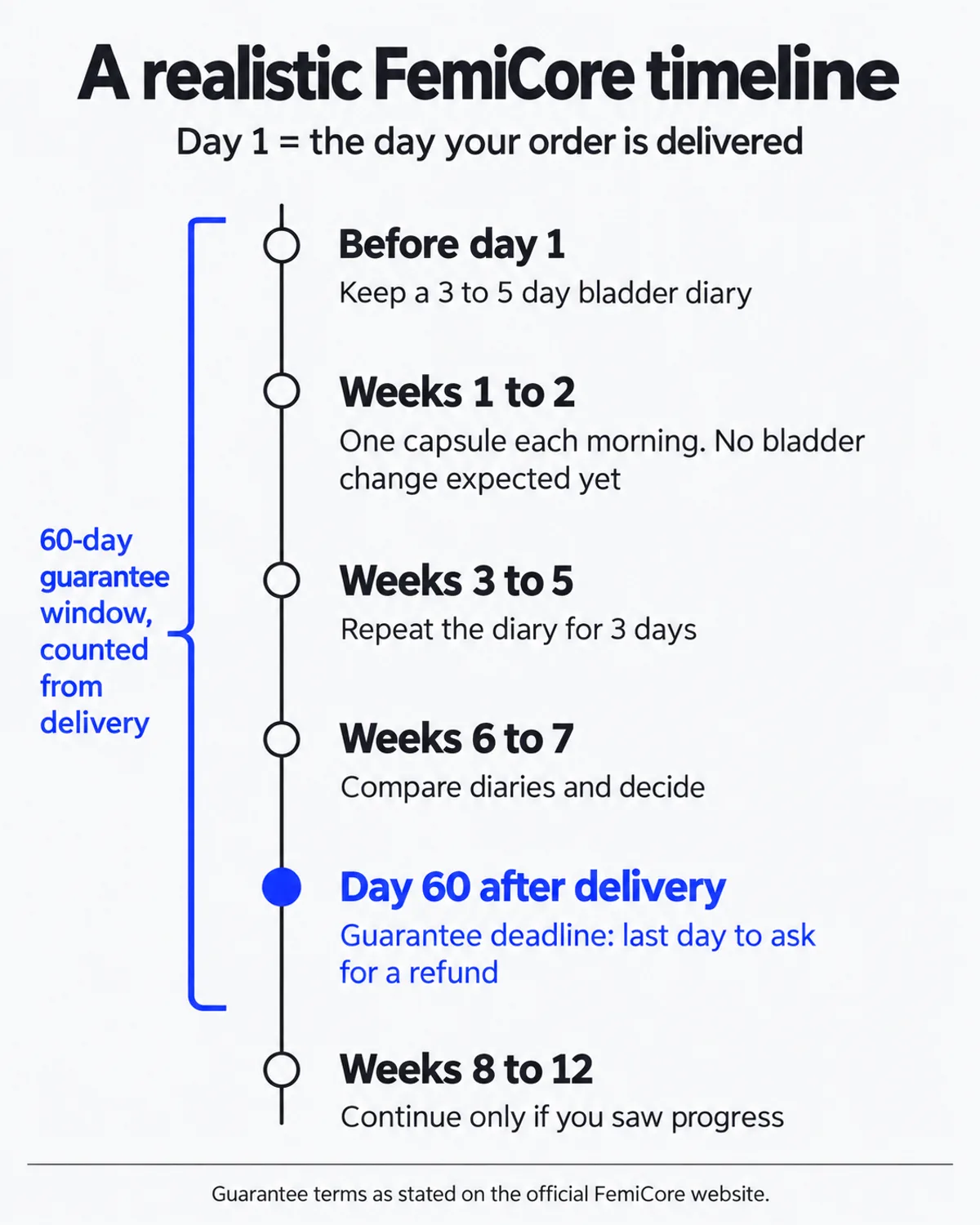
Run it as a test with an end date. The vendor suggests at least 3 months, but the refund closes 60 days after delivery, so the comparison of your two diaries needs to happen before then. Our benefits map shows which claims have any evidence behind them, and our long read on whether FemiCore works covers expectations in more depth.
What would change this comparison
Two things would move FemiCore up this page: a published dose for every ingredient (so each one could be set against its own research) and a trial of the finished capsule in women with bladder symptoms. Neither exists today. Until then, routes with direct or checkable evidence keep an edge for the problems they were studied for.
Which route first: a decision list
- Blood in the urine, fever, chills, flank pain, burning or a sudden loss of control? Go to a doctor. Do not start any supplement first.
- Pregnant, breastfeeding, kidney disease, or taking diabetes, blood pressure, warfarin, lithium or transplant medicines? Talk to a doctor before FemiCore; several of its ingredients are flagged for you.
- Main problem is repeat urinary infections? Discuss it with a doctor, and ask whether a cranberry product with a stated PAC dose makes sense.
- Main problem is leaking? Ask about pelvic floor muscle training, the route studied directly for leaks.
- You want a probiotic you can check against research? Look for a single-strain product that prints its strain code and CFU count.
- Mild bother, already checked by a doctor, and curious about a blend? FemiCore is a reasonable thing to test for up to 60 days, with a diary and a firm stop date.
Can the routes be combined?
Some can. Pelvic floor training and a supplement do not compete, and a doctor’s assessment helps with any of the others. Doubling up on supplements is different: FemiCore already includes cranberry and five probiotic species, so adding another cranberry or probiotic product stacks amounts you cannot see. Ask a pharmacist first, especially if you take warfarin or have a history of kidney stones. For the ingredient-level details, see the FemiCore ingredient reference, and for package costs, the FemiCore price page.
Official bundle pricing
As listed on the official store · confirm at checkout
2 bottles

$358seller's regular price
$158
$79 per bottle
Seller lists a $200 saving
- $9.99 US shipping
- 60-day guarantee
3 bottles

$537seller's regular price
$207
$69 per bottle
Seller lists a $330 saving
- Free US shipping
- 60-day guarantee
6 bottles

$1,074seller's regular price
$294
$49 per bottle
Seller lists a $780 saving
- Free US shipping
- 3 bonus guides
- 60-day guarantee
Regular prices and savings are the seller's own reference figures. Refunds: 60 days from delivery. Affiliate links: we may earn a commission at no extra cost to you.
Frequently asked questions
Is FemiCore better than a plain cranberry supplement?
Nobody has tested that. FemiCore adds probiotics and other botanicals, but it does not state its cranberry PAC content. For repeat UTIs, the evidence is about cranberry at an adequate PAC dose, so a product that discloses it is easier to match to research.
Should I try pelvic floor exercises instead of FemiCore?
If leaks are your main problem, ask your doctor or a pelvic health physiotherapist about pelvic floor muscle training. It has been studied directly in women with urinary incontinence, which is more than any ingredient in FemiCore can claim.
Is a single-strain probiotic a better choice?
It can be easier to judge. Probiotic effects depend on the exact strain, and a single-strain product that names its strain code can be checked against studies. FemiCore lists five species with no strain codes or CFU count.
Do I need to see a doctor before trying FemiCore?
For new, worsening or painful symptoms, yes. Blood in the urine, fever, flank pain, burning or a sudden change in bladder control need a diagnosis. A doctor can also check your medicines against berberine and bearberry before you start.
Can I take FemiCore with a cranberry supplement?
FemiCore already contains cranberry, so stacking adds more of an amount you cannot see. If you take warfarin or have had kidney stones, cranberry needs particular care. Ask a pharmacist before combining the two.
Sources
- 01 Williams G, et al. Cranberries for preventing urinary tract infections. Cochrane Database Syst Rev. 2023
- 02 Stapleton AE, et al. Lactobacillus crispatus probiotic given intravaginally for prevention of recurrent UTI. Clin Infect Dis. 2011
- 03 Dumoulin C, et al. Pelvic floor muscle training versus no treatment, or inactive control treatments, for urinary incontinence in women. Cochrane Database Syst Rev. 2018
- 04 NIDDK. Bladder control problems (urinary incontinence)
- 05 NIDDK. Bladder infection (urinary tract infection) in adults
- 06 NIH Office of Dietary Supplements. Probiotics: Fact Sheet for Health Professionals
- 07 FTC. Health products: compare claims before you buy
femicore comparison · femicore alternatives · femicore vs cranberry · femicore vs probiotics · femicore pelvic floor training · femicore bladder options