Women's Wellness/Benefits
FemiCore Label Claims Checked Against the Evidence: Urinary Health, Bladder Control, Microbiome
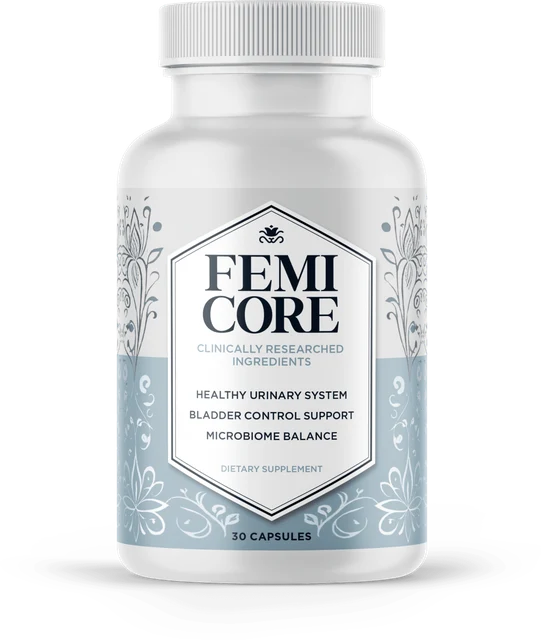
Each FemiCore label claim mapped to the ingredients behind it and a plain evidence rating, plus a realistic outcome, a timeline and what the capsule cannot do.
- From $49 per bottle
- 60-day refund
- Women's Wellness
By Supplement Health Expert Editorial Team · · 6 min read
- Refund window
- 60 days from delivery
- Lowest per bottle
- $49 largest bundle
- Category
- Women's Wellness
- Our score
- 6.3/10 editorial
Key takeaways
- 01 FemiCore makes three label claims: a healthy urinary system, bladder control support and microbiome balance.
- 02 Only one link in the chain, cranberry for repeat UTIs, has moderate human evidence, and even that depends on a dose FemiCore does not disclose.
- 03 Bladder control, the reason most women look at FemiCore, has no human evidence for any of its ingredients.
- 04 A fair outcome to hope for is a modest change you can measure in a bladder diary, not an end to leaks.
- 05 New, painful or sudden symptoms belong with a doctor before any supplement.
FemiCore’s bottle makes three short promises. This page takes each one, names the ingredients that are supposed to deliver it, and gives the research behind them a plain strength rating. The ratings describe the ingredients in the form they were studied, because the capsule itself has never been trialled. For a narrative version, read our long read on the benefits of FemiCore.
The claim map
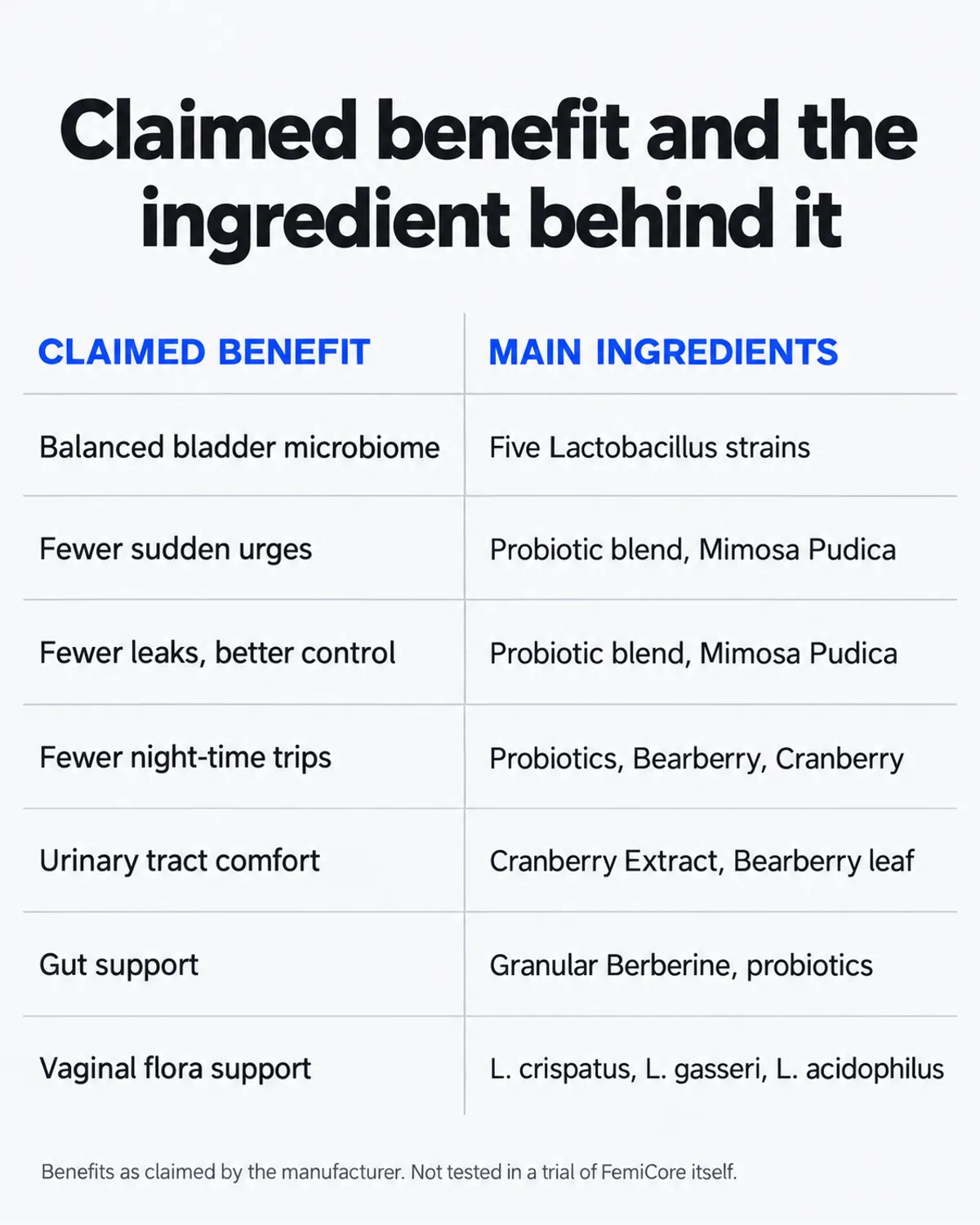
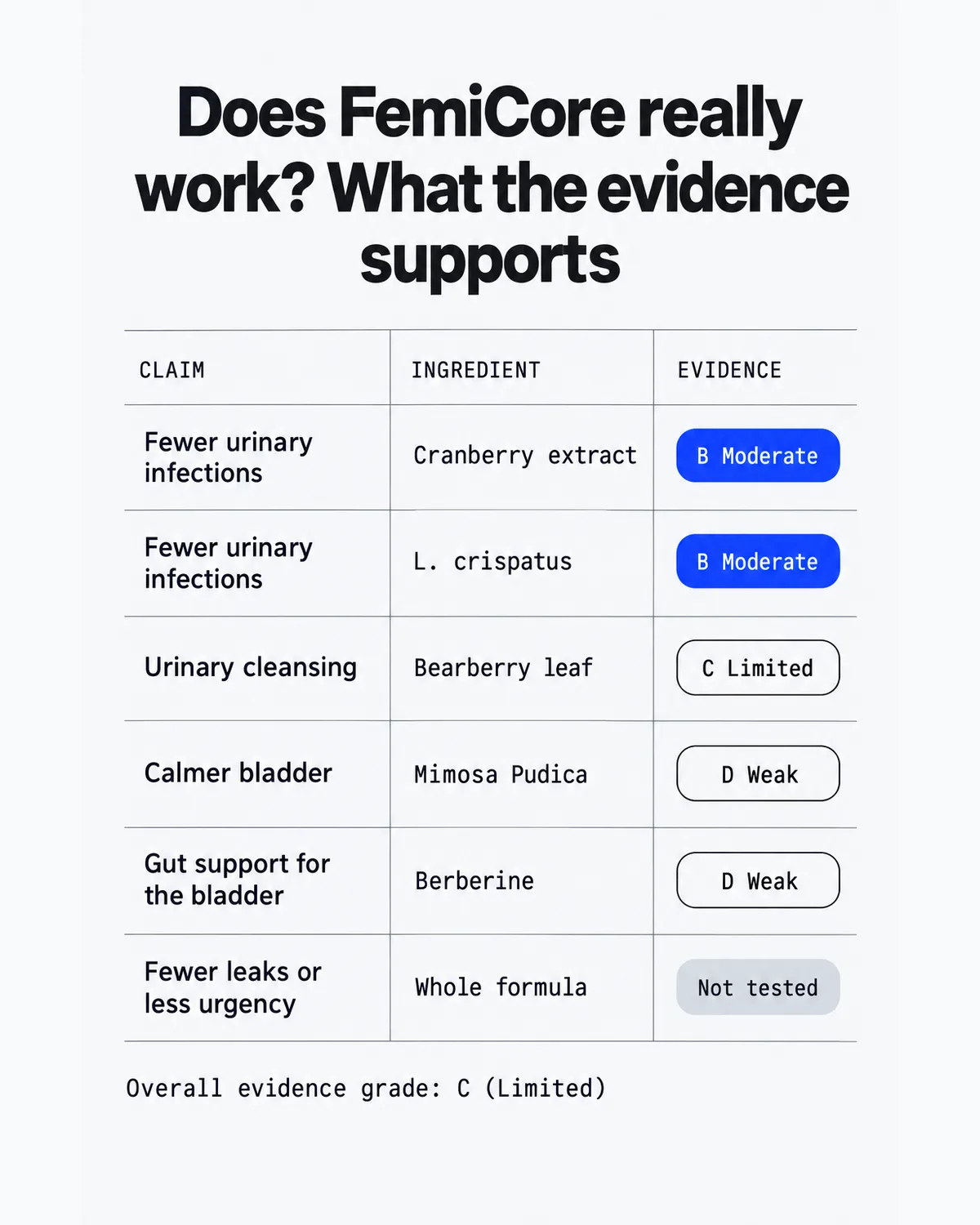
| Seller’s claim | Ingredient(s) | Strength of research |
|---|---|---|
| Healthy urinary system | Cranberry extract | Moderate (repeat UTIs only) |
| Healthy urinary system | Bearberry | Limited, mixed |
| Healthy urinary system | L. crispatus | Limited (vaginal use) |
| Bladder control support | Mimosa pudica | Very limited (lab, animal) |
| Bladder control support | Probiotic blend | Very limited |
| Bladder control support | Cranberry, berberine | None for this use |
| Microbiome balance | Five Lactobacillus species | Very limited |
| Whole formula, any claim | All nine together | None (never tested) |
How we use the four ratings
- Moderate: human trials pooled in a systematic review show an effect, with caveats.
- Limited: some human data, small or mixed, or in a different form from a swallowed capsule.
- Very limited: lab, animal or observational findings only.
- None for this use: the ingredient may have human data, but not for this claim.
Claim 1: a healthy urinary system
What the seller implies: the cranberry, bearberry and probiotic parts keep the urinary tract in good shape.
What the research shows:
- Cranberry supplies A-type PACs, which interfere with E. coli attaching to the bladder wall. The 2023 Cochrane analysis concluded that, for women who get UTIs again and again, cranberry products can lower how often they come back. Older reviews had not agreed with each other.
- Bearberry contributes arbutin, which the body converts to hydroquinone; in urine samples tested in the lab, that compound acts against bacteria. Trials in people are few and point in different directions. European herbal regulators recognise it for mild lower urinary complaints, as a week-long course at most.
- An L. crispatus product placed vaginally reduced repeat UTIs in a small placebo-controlled trial.
The gap: every result above depends on dose or form. FemiCore hides its PAC and arbutin content, and its L. crispatus is swallowed, with no strain named.
Claim 2: bladder control support
What the seller implies: fewer sudden urges and fewer leaks.
What the research shows: this is the weakest of the three claims, even though it is the one most buyers care about. Mimosa pudica has anti-inflammatory and antispasmodic reports from lab and animal work only, with no human trials for bladder symptoms. The probiotic argument rests on early microbiome studies (next section). Cranberry was studied for infections, not leaks. Berberine’s human data concern blood sugar and cholesterol.
The gap: neither the formula nor any single ingredient has evidence in people for fewer leaks or less urgency.
Claim 3: microbiome balance
What the seller implies: five Lactobacillus species rebalance the bacteria of the urinary tract.
What the research shows: around 2012, researchers using DNA sequencing (Loyola University Chicago among them) reported bacteria in the female bladder. Several of these studies noted a smaller Lactobacillus share in women with urgency incontinence. The theory is reasonable, but it is an association, and nothing in it shows that an oral probiotic shifts bladder symptoms.
The gap: probiotic effects belong to particular strains. FemiCore lists species only, with no strain codes and no CFU count.
What a realistic outcome looks like
Set expectations by what the evidence can carry:
- Best case: a modest, measurable change, such as slightly fewer urgent trips logged in a diary. Nothing in the research promises even that.
- Likely case: little or no change you can separate from day-to-day variation.
- Not on the table: an end to leaks, protection from infections you can count on, or a replacement for medical care.
Measure it yourself: what to log in a bladder diary
Because no trial tells you what FemiCore does, your own record is the only result you will get. A paper notebook or a phone note is enough. Log the same items for a few days before the first capsule and again a few weeks in:
- Every trip to the toilet, with the time
- Which of those trips felt urgent or hard to delay
- Any leak, and what you were doing when it happened
- How many times you got up at night to pass urine
- Roughly what and how much you drank
Compare the two snapshots side by side. A difference you have to squint to see is not a benefit worth paying for each month. A diary is also useful to bring to a doctor, whatever you decide about the supplement.
Who these claims are pitched at
The claims fit best when bladder symptoms are mild, a medical check has already been done, and the aim is to try a probiotic blend. They fit poorly if your main problem is frequent infections, where a cranberry product that states its PAC dose is easier to judge, or if you have any of the warning signs listed further down.
Timeline: the vendor’s 3 months vs the 60-day refund
| Point | What to do |
|---|---|
| Before the first capsule | Keep a bladder diary for a few days |
| Day 1 (delivery day) | The 60-day refund clock starts |
| First two weeks | Take the daily morning capsule with plenty of water; no bladder change is expected this early |
| Weeks 4 to 7 | Repeat the diary and compare |
| Before day 60 | Decide: keep going or request a refund |
| Around month 3 | Earliest point the vendor says results should be judged |
The mismatch is worth noting. The vendor says to give it at least 3 months, but the guarantee runs out 60 days after delivery. If keeping the refund option matters to you, your decision has to come first. Timing is covered at more length in our evidence and timeline long read.
What FemiCore cannot do
- It cannot diagnose why you leak or feel urgency.
- It cannot replace medical care when an infection is present.
- It cannot be matched to studied doses, because none of its amounts are shown.
- It cannot rely on the label phrase “clinically researched”, which describes the ingredients in general, not the capsule.
When to see a doctor instead
Some symptoms point to a problem that needs a diagnosis, and a supplement would only delay it. Book an appointment first if you notice:
- Blood in the urine
- Fever, or chills
- Flank pain (one side of the lower back)
- Burning on urination
- A sudden shift in how well you control your bladder
- An older relative who becomes confused while having urinary symptoms
The FemiCore safety sheet covers interactions and who should ask first, and the comparison of other routes sets FemiCore against cranberry alone, probiotics and pelvic floor training.
Official bundle pricing
As listed on the official store · confirm at checkout
2 bottles

$358seller's regular price
$158
$79 per bottle
Seller lists a $200 saving
- $9.99 US shipping
- 60-day guarantee
3 bottles
$537seller's regular price
$207
$69 per bottle
Seller lists a $330 saving
- Free US shipping
- 60-day guarantee
6 bottles
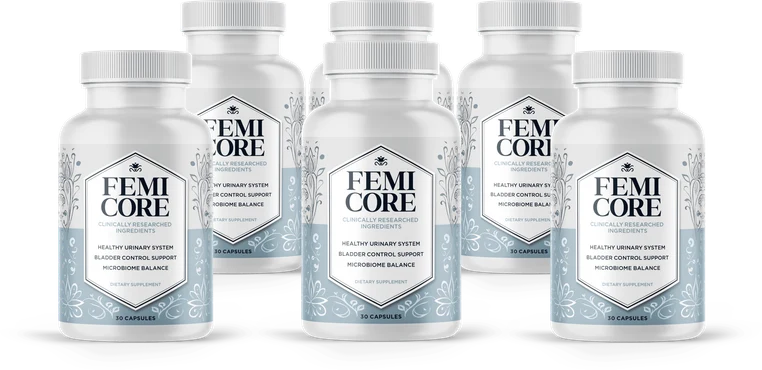
$1,074seller's regular price
$294
$49 per bottle
Seller lists a $780 saving
- Free US shipping
- 3 bonus guides
- 60-day guarantee
Regular prices and savings are the seller's own reference figures. Refunds: 60 days from delivery. Affiliate links: we may earn a commission at no extra cost to you.
Frequently asked questions
What benefits does FemiCore claim?
The label lists three: a healthy urinary system, bladder control support and microbiome balance. These are the seller's claims. They are general support statements, and none of them has been tested in a trial of the finished FemiCore capsule.
Can FemiCore stop bladder leaks?
There is no evidence that it can. None of the nine ingredients has human trial data for leaks or urgency, and the blend itself has never been tested. Leaks have several possible causes, so a doctor's assessment is the sensible first step.
How long before FemiCore shows any benefit?
The vendor advises at least 3 months. The refund window, though, is 60 days from delivery, so if you want the option of a refund you need to judge your results earlier, ideally with a simple bladder diary kept before and during use.
Does FemiCore help with urinary tract infections?
FemiCore is not sold as a remedy for infections, and it should not replace a doctor for one. Its cranberry content links it to research on repeat UTIs, but that research depends on a PAC dose FemiCore does not state.
Is the microbiome balance claim backed by science?
The idea comes from real research: since about 2012, studies have found bacteria in the female bladder, with fewer Lactobacillus in some women with urgency incontinence. That is early science, and it does not prove that oral probiotics change bladder symptoms.
Sources
- 01 Williams G, et al. Cranberries for preventing urinary tract infections. Cochrane Database Syst Rev. 2023
- 02 Pearce MM, et al. The female urinary microbiome in women with and without urgency urinary incontinence. mBio. 2014
- 03 Wolfe AJ, et al. Evidence of uncultivated bacteria in the adult female bladder. J Clin Microbiol. 2012
- 04 Stapleton AE, et al. Lactobacillus crispatus probiotic given intravaginally for prevention of recurrent UTI. Clin Infect Dis. 2011
- 05 NIDDK. Bladder control problems (urinary incontinence)
- 06 NIDDK. Bladder infection (urinary tract infection) in adults
- 07 FTC. Health products: compare claims before you buy
femicore benefits · femicore claims · femicore evidence · femicore bladder control · femicore urinary health · femicore results